


Summary
A Park Hill home's value depends on far more than price per square foot. Architecture, original craftsmanship, lot and block, floor plan, renovation quality, systems, and future improvement potential all matter. In older homes especially, the relationship between original character and modern functionality can materially change how buyers perceive value.
Park Hill is unusual because two homes with similar square footage can have dramatically different values.
A 2,500-square-foot house with an exceptional lot, intact architectural details, a thoughtful floor plan and a high-quality renovation can compete very differently from another 2,500-square-foot house that happens to sit a few blocks away.
That is why I do not begin evaluating a Park Hill property by dividing the sale price by the number of square feet.
Price per square foot is useful. It is simply not enough.
When I evaluate a home in Park Hill, I am trying to understand what makes the property difficult to replicate. That means looking beyond the finished rooms to the architecture, setting, block, underlying condition and possibilities that may not be obvious during a first showing.
Architecture Often Creates the Value That Square Footage Cannot
Architecture and original craftsmanship can create a meaningful premium because they are characteristics that cannot simply be added during a renovation.
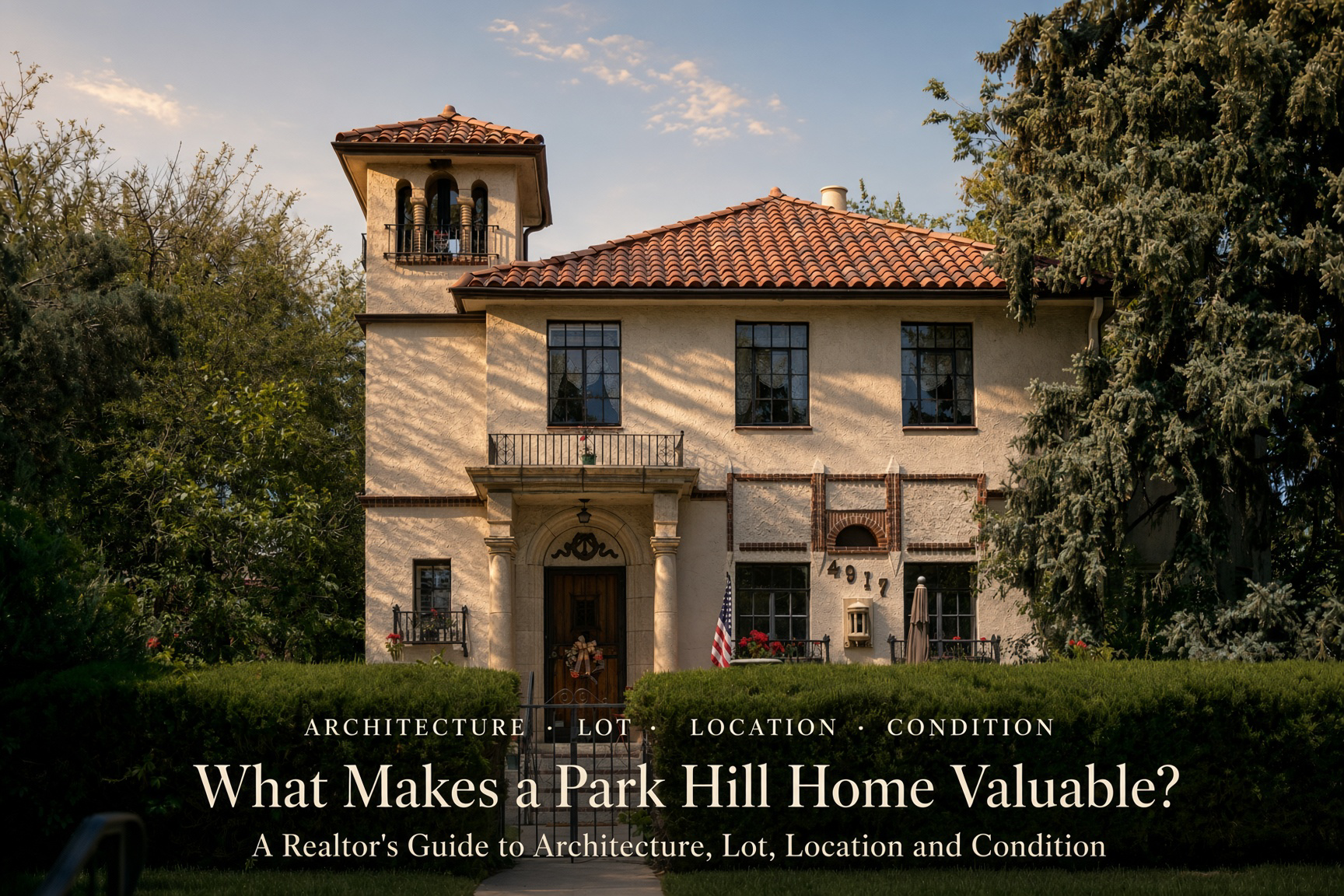
Park Hill's housing stock includes a remarkable range of early-20th-century homes, including Tudors, Mediterranean Revival properties, Craftsman homes, brick Denver Squares and other distinctive designs. Within that stock, original clinker brick, leaded glass, Batchelder tile, coved ceilings, original millwork, hardwood floors and unusual masonry details can materially affect buyer perception.
The important distinction is between old and architecturally significant.
Age alone does not make a house valuable. A 1915 house that has lost most of its defining details may offer a very different ownership proposition from a similarly aged home that retains its original craftsmanship.
Having renovated older Denver homes myself, I have learned to ask a simple question: What would be difficult or impossible to recreate?
That question often tells me more than the age of the property.
The Lot and the Block Matter More Than Many Buyers Realize
A strong Park Hill property is partly defined by what surrounds it, not just what is inside it.
Lot width, depth, mature landscaping, orientation, privacy, garage placement and the relationship between the house and the street can materially change how a property lives. Two homes with similar floor plans can feel completely different if one has a deeper lot, better outdoor connection or more desirable relationship to the surrounding streetscape.
The same is true at the block level.
Park Hill is not a uniform real estate market. Buyer preferences can change from one section of the neighborhood to another, and even adjacent blocks can offer different combinations of architecture, traffic, walkability, views, parks and housing stock.
That is why I pay attention to the specific block rather than simply treating "Park Hill" as a single comparable.
For a buyer, the practical rule is straightforward: do not evaluate a Park Hill house without evaluating the land and the immediate surroundings with equal attention.
Floor Plan Can Determine Whether Character Becomes Livable
Original character may attract a buyer, but functionality often determines whether that buyer can live with the house long term.
Older Denver homes frequently have beautiful proportions and architectural details but floor plans that reflect a different era. Small kitchens, limited closet space, awkward circulation or a lack of a main-floor primary suite can create functional compromises.
The question is not simply whether the floor plan works today. It is whether it can be improved without destroying what makes the house special.
I often think about this as a character-to-function test.
If a property has exceptional architecture but limited functionality, I want to understand whether the two can coexist after renovation. A well-designed addition or reconfiguration can sometimes create substantially more value than simply adding finished square footage.
That distinction matters because adding 500 square feet is not automatically better than improving the 2,500 square feet already there.
Renovation Quality Is More Important Than Renovation Cost
A renovated house is not necessarily a valuable house. The quality, proportion and compatibility of the renovation matter.
In Park Hill, I look for whether a renovation respects the original architecture while solving the practical problems of an older home. A generic renovation can remove the very qualities that made the property distinctive in the first place.
That is particularly important in a neighborhood where buyers may be seeking something they cannot easily find in newer construction.
A useful comparison is:
| Renovation approach | Potential benefit | Primary risk |
|---|---|---|
| Cosmetic update | Lower upfront cost | May leave major systems or functional issues |
| Full generic remodel | Modern functionality | Can erase architectural character |
| Character-sensitive renovation | Function plus preservation | Requires more planning and design discipline |
| Strategic addition | Meaningful change in livability | Cost, permitting and design complexity |
The objective is not to spend the most money. It is to spend money where it improves the property's position relative to competing homes.
Systems and Deferred Maintenance Can Change the Entire Equation
Beautiful finishes can distract buyers from expensive problems.
When evaluating an older Park Hill home, I want to understand the condition of the foundation, roof, plumbing, electrical, HVAC, windows and other major systems before treating cosmetic appeal as evidence of value.
This is one area where my finance background influences how I think about real estate. I separate visible condition from underlying risk.
A dated kitchen is usually easy to identify. A deteriorating sewer line, aging electrical system or foundation issue may be less obvious, but potentially far more consequential.
The practical question is not simply, "How much will this house cost to update?"
It is, "How much capital is required to make this house function the way I want, and what will I have after that investment?"
That distinction is critical when comparing a $1 million house requiring substantial work with a $1.2 million house that is already substantially renovated. The $200,000 difference in purchase price may not represent the actual financial difference between the two options.
Addition Potential Can Be More Valuable Than Finished Square Footage
One of the most interesting Park Hill opportunities is a house whose existing architecture is strong but whose functionality is incomplete.
A property may have enough lot area and a logical place for an addition that could create a main-floor primary suite, expand a kitchen or improve the connection between indoor and outdoor spaces.
But addition potential should never be treated as guaranteed value.
Before assigning significant value to an expansion opportunity, I want to understand the physical constraints, zoning and permitting considerations, architectural implications, construction cost and likely buyer demand after the work is completed.
The best addition is not necessarily the largest one.
In older Denver homes, strategic square footage can sometimes change the category of the property more effectively than simply maximizing total size. A thoughtful 400-square-foot addition that solves a major functional deficiency can potentially matter more than several hundred square feet of less useful space.
Future Buyers Matter When You Are Buying for the Long Term
The final question I ask is not only what I think a property is worth today. It is what a future buyer is likely to value.
That does not mean trying to predict the market years in advance. It means identifying characteristics that are structurally difficult to reproduce.
Original architecture is difficult to recreate. A good block cannot be relocated. A mature lot cannot be manufactured overnight. High-quality craftsmanship is expensive to reproduce. A thoughtful floor plan can be difficult to achieve without compromising the original structure.
This creates an important distinction between apparent value and durable value.
A house can look expensive because it has new countertops, lighting and paint. Another may justify its price because it combines architecture, setting, functionality and quality in a way that would be difficult for another buyer to replicate.
That is the type of value I want to understand when evaluating a Park Hill property.
The Park Hill Value Test
When I walk through an older Park Hill home with a buyer, I am essentially trying to answer five questions:
- What is irreplaceable?
Architecture, craftsmanship, lot, setting and block. - What is functional today?
Floor plan, systems, storage, kitchen, bedrooms and everyday livability. - What is fixable?
Cosmetic issues and functional deficiencies that can be addressed without compromising the property's character. - What is risky?
Major systems, deferred maintenance, structural concerns and renovation assumptions that have not been verified. - What will still matter to the next buyer?
The characteristics that are difficult to recreate and consistently influence how the property is experienced.
That framework is more useful than relying on a single price-per-square-foot calculation.
For buyers, it helps identify where they may be paying for genuine scarcity versus simply paying for size or finishes. For sellers, it helps explain which improvements are likely to strengthen the property's position and which may simply increase the cost basis without producing equivalent market value.
Park Hill rewards that distinction. Its most compelling homes are rarely valuable for one reason. They are valuable because architecture, land, location, functionality and condition come together in a combination that is difficult to reproduce.
That is ultimately how I think about value in an older Denver home: not simply what is there today, but what would be difficult to recreate if it were gone.
If you're thinking about buying, selling or renovating a Park Hill home and want to stay connected to my perspective on Denver real estate, historic homes and renovation, Let's connect.
If you are evaluating a Park Hill property, I can help you look beyond the obvious numbers and assess the architecture, lot, block, condition, renovation potential and long-term value as a complete picture.
Key Takeaways
- Price per square foot is only one input. In Park Hill, architecture, lot, block, floor plan, condition and renovation quality can materially change the value of similarly sized homes.
- Original craftsmanship has scarcity value. Features such as clinker brick, leaded glass, Batchelder tile, original millwork and distinctive masonry can be difficult or impossible to recreate.
- The block matters. Park Hill is a collection of micro-markets rather than a uniform housing market, so the immediate streetscape and surrounding housing stock deserve individual consideration.
- Renovation quality matters more than renovation spending. A character-sensitive renovation can improve functionality without sacrificing the architectural qualities that differentiate an older home.
- Separate visible problems from underlying risk. A dated kitchen and an aging sewer line may both require work, but they have very different implications for cost and ownership risk.
- The best long-term value is often what cannot easily be reproduced. A good lot, exceptional architecture, strong setting and thoughtful floor plan can create durable value beyond today's finishes.
FAQ
What makes a Park Hill home valuable?
A Park Hill home's value is influenced by architecture, original details, lot and block, floor plan, renovation quality, systems, condition and future improvement potential. Square footage matters, but it does not capture all of those variables.
Does original architecture increase the value of an older Park Hill home?
It can. Original architectural elements such as clinker brick, leaded glass, tile, millwork and distinctive masonry can differentiate a property because they are difficult to reproduce. Their importance also depends on how well they integrate with the home's overall condition and functionality.
Is a renovated Park Hill home always worth more than a fixer?
Not necessarily. The answer depends on renovation quality, purchase price, remaining risks, architectural character and what improvements are possible. A fixer with exceptional underlying characteristics may offer opportunities that a fully renovated but less distinctive property does not.
How important is the specific block in Park Hill?
Very important. Park Hill contains different housing types, architectural styles, streetscapes and micro-markets. Two properties within a relatively short distance can have different buyer appeal because of their immediate setting, traffic, housing stock and relationship to parks or other neighborhood amenities.
Should I pay more for a Park Hill house with addition potential?
Only after determining that the addition is realistically achievable and financially sensible. Construction cost, zoning and permitting considerations, lot constraints, architectural compatibility and the likely finished value all need to be considered before assigning meaningful value to an expansion opportunity.
What should buyers inspect most carefully in an older Denver home?
Major systems and deferred maintenance deserve particular attention. Foundation, roof, plumbing, electrical, HVAC, windows and other significant components can have much larger financial implications than cosmetic updates.
What matters most for the future resale value of a Park Hill home?
Characteristics that are difficult to reproduce generally deserve particular attention: architectural integrity, lot and setting, desirable block location, thoughtful functionality and high-quality renovation. Those attributes can help differentiate a property from homes that compete primarily on size or finishes.
Check out this article next