

Summary
Pricing a Denver home below its expected market value can create more buyer engagement, emotional attachment, and competition, which can ultimately produce a higher sale price. Two recent Denver sales, 1728 Jasmine St and 475 N Washington St, demonstrate how strategic pricing can generate multiple offers and stronger negotiating leverage when the home itself delivers.
Denver homeowners face an unusual pricing challenge. Buyers are already confronting high home prices, elevated mortgage rates, and a high cost of living. That means a listing that feels even slightly overpriced can be easy to dismiss, particularly when buyers have plenty of other decisions competing for their attention.
But there is another way to think about pricing.
Instead of asking, "What is the highest number we can put on the listing?" a seller can ask, "What price will make the largest number of qualified buyers want to see this house?"
That distinction matters because a listing price is not simply a statement of value. It is also a marketing tool.
The goal of strategic underpricing is not to convince buyers that a home is worth less than it really is. The goal is to create enough initial interest to get buyers through the door. Once buyers see a home that fits their needs, appreciate its architecture and condition, and begin imagining themselves living there, the conversation can change from whether the house is worth seeing to how much they are willing to pay to own it.
Two recent Denver transactions illustrate the strategy particularly well.
Why a Lower List Price Can Create More Buyer Competition
Pricing a home below its expected market value can increase the number of buyers willing to engage with the property because the lower entry point creates the perception of an opportunity. If several buyers independently decide they do not want to miss that opportunity, the seller can move from negotiating with one buyer to having several buyers compete against one another.
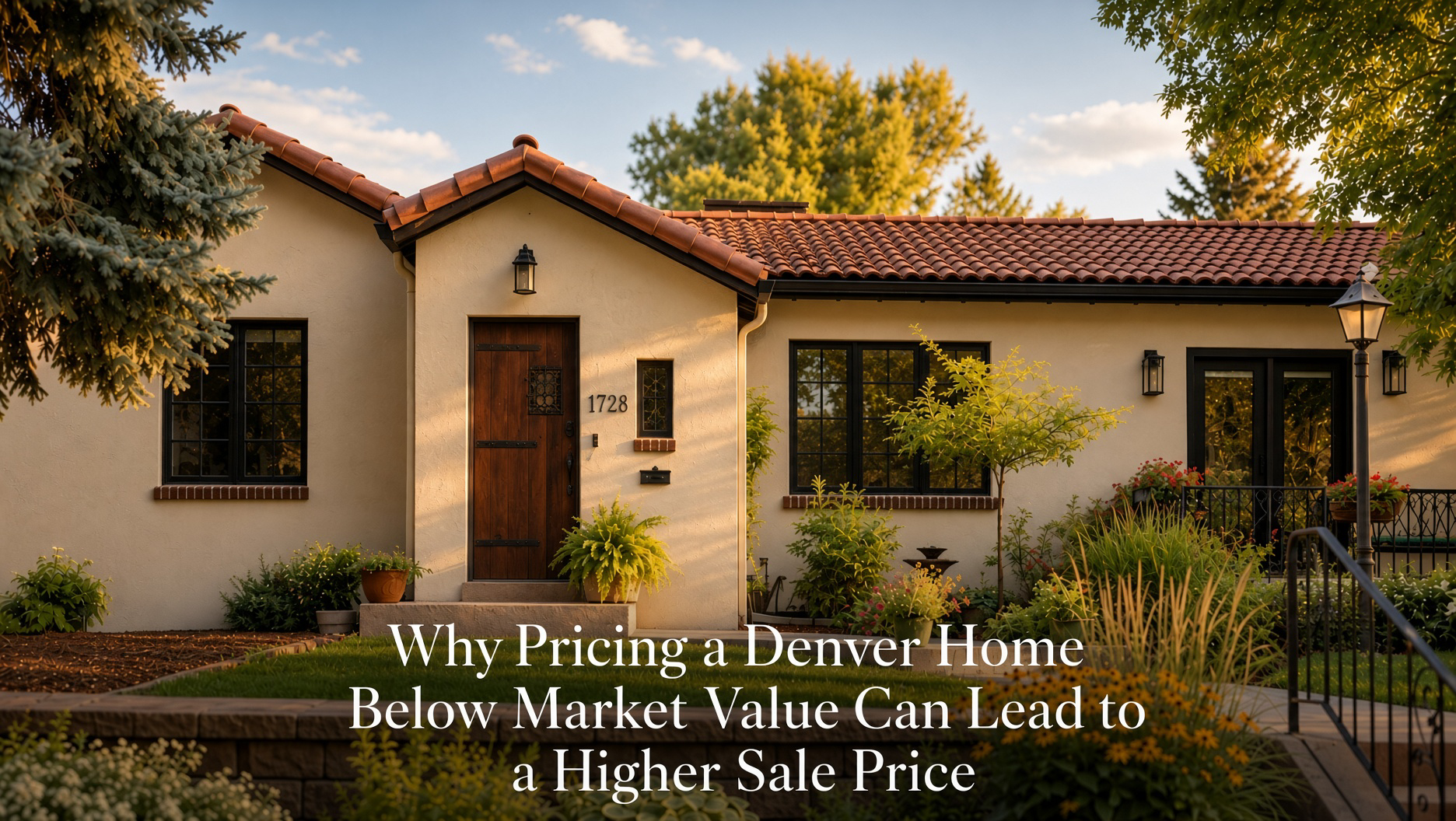
That dynamic was evident at 1728 Jasmine St. The home was listed at $1,899,000, below its expected market value, and sold for $2,025,000 after just two days on the market.
The result was $126,000 above the asking price.
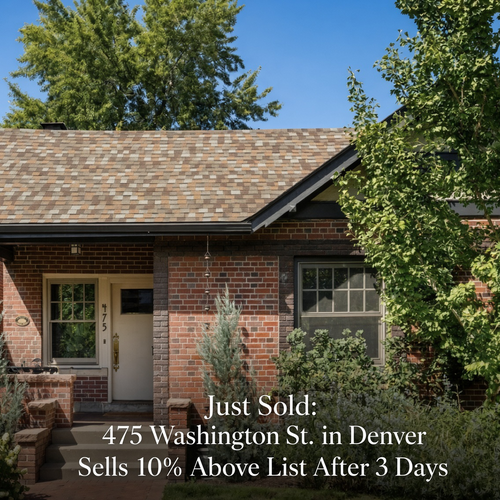
A similar strategy worked at 475 N Washington St, a 1916 Craftsman half-duplex in Alamo Placita. The home was listed at $599,900 and sold for $660,000 after three days, a $60,100 increase over the list price.
| Property | List Price | Sale Price | Above List | Days on Market |
|---|---|---|---|---|
| 1728 Jasmine St | $1,899,000 | $2,025,000 | $126,000 | 2 |
| 475 N Washington St | $599,900 | $660,000 | $60,100 | 3 |
These are not examples of simply "pricing low and hoping." They demonstrate a deliberate sequence: attract attention, generate showings, create emotional interest, and then allow competition to establish the final price.
The Price Gets Buyers In. The House Has to Close the Deal.
Strategic underpricing only works when the property gives buyers a reason to become emotionally invested once they arrive.
That is especially important with older Denver homes. Character, craftsmanship, layout, renovation quality, and the relationship between original architecture and modern functionality can make a property difficult to evaluate using price-per-square-foot alone.
475 N Washington St is a good example. Built in 1916, the home combined preserved woodwork, built-ins, wood floors, a fireplace, and original wainscoting with a remodeled kitchen, renovated bathroom, updated systems, newer windows, HVAC, and a newer garage.
The distinction is important: the home was not simply inexpensive. The lower price created the reason to look, while the quality and character of the house created the reason to compete.
I see this as a useful pricing rule for Denver's older housing stock:
Price can generate the showing, but condition, character, and livability have to generate the emotional commitment.
That is particularly relevant in neighborhoods where buyers are comparing renovated historic homes with new construction, heavily remodeled properties, and homes that still require significant work.
A buyer may be willing to stretch for the right house. It is much harder to convince that same buyer to stretch for a house that feels like a project unless the price already reflects the work required.
Why This Strategy Can Be Especially Effective in a High-Cost Market
In a market where buyers are paying substantial prices for homes while also dealing with elevated mortgage rates and other living costs, affordability is not just about the purchase price. It is about the buyer's overall financial commitment.
A lower list price can therefore change who decides to engage with a property.
A buyer who would ignore a $2.1 million listing might pay close attention to a home listed at $1.9 million if the house appears capable of meeting their needs. A buyer who assumes a $700,000 home is out of reach may investigate one listed at $599,900.
That initial difference matters because buyers cannot emotionally compete for a home they never consider.
The objective is to get the property into the consideration set of enough qualified buyers that competition becomes possible.
This is where pricing becomes more than valuation. It becomes behavioral strategy.
The seller is effectively trading some certainty about the initial asking price for the possibility of greater buyer participation. If the strategy succeeds, the market, rather than the list price alone, determines how far the price ultimately moves.
The Best Candidates for Strategic Underpricing Have a Strong "Payoff" Once Buyers Arrive
Not every Denver home is a good candidate for this strategy. The biggest mistake is assuming that a lower price can compensate for a property that does not deliver once buyers walk through the door.
The strategy is better suited to homes with characteristics that can create a strong emotional response, particularly when those characteristics are difficult to communicate fully through an online listing.
For an older Denver home, that might include:
- Preserved architectural details that are difficult to replicate
- A thoughtful renovation that balances character with modern functionality
- A layout that solves a common buyer problem
- Strong outdoor space or a particularly desirable lot
- Updated infrastructure that reduces immediate ownership risk
- A combination of location and condition that is difficult to find
475 N Washington St illustrates this combination particularly well. The home paired its 1916 Craftsman character with a carefully designed renovation. Buyers were not simply being offered square footage. They were being offered a finished home with a specific architectural identity.
1728 Jasmine St provides another example of how the strategy can work with a distinctive older Denver property.
The common thread is not simply that both homes were priced below market. It is that both homes had enough underlying appeal to turn initial curiosity into genuine buyer competition.
Strategic Underpricing Is Really About Creating Negotiating Leverage
The most important benefit of multiple offers is not necessarily the headline sale price. It is the change in the seller's negotiating position.
With one interested buyer, the seller and buyer are negotiating against each other.
With multiple interested buyers, each buyer knows there is competition. That can affect not only price, but also the other terms of the transaction.
A strong offer can therefore involve more than simply increasing the purchase price. Depending on the circumstances, sellers may also care about inspection terms, financing certainty, appraisal considerations, closing timing, earnest money, or other contractual provisions.
This is why I think about pricing strategy as a way to create leverage rather than simply maximize the list price.
The goal is to create enough demand that the seller has choices.
The two recent sales provide a useful illustration. Jasmine sold $126,000 above its $1,899,000 list price, while Washington sold $60,100 above its $599,900 list price. In both cases, the seller reached a competitive environment within three days or less.
That does not mean every strategically underpriced home will produce the same result. It does demonstrate the potential payoff when pricing, property condition, presentation, and buyer demand align.
How I Think About the Risk of Pricing Too Low
Underpricing carries a real risk: if the property does not generate sufficient interest, the seller has established a lower reference point without creating the competition needed to move the price back up.
That is why I would not use a simple percentage discount as a universal formula.
Instead, I would evaluate three things together:
1. How compelling is the house?
Will buyers understand the value immediately when they walk through the door?
2. How much competition exists for similar homes?
Is the property genuinely differentiated, or are buyers looking at several comparable alternatives?
3. How much buyer activity is required for the strategy to work?
A home that needs multiple buyers to compete cannot be priced using the same logic as a home that is likely to attract only one or two serious prospects.
Having renovated older Denver homes myself, I have learned that condition matters enormously to the value equation. A lower asking price may attract someone to a renovation project, but the buyer still has to account for construction, design, permitting, time, and uncertainty. A beautifully executed renovation removes much of that friction.
That is why the Jasmine and Washington examples are useful. Both were older homes where the character had been preserved and the updates were already done. The price got buyers interested, but the houses gave them a reason to stay interested.
What Sellers Should Take Away
Strategic underpricing is not about giving a home away. It is about recognizing that the first job of a listing price is to generate buyer engagement.
In the right circumstances, a seller may be better served by creating urgency around a compelling price than by establishing a higher asking price and waiting for one buyer to agree.
But the strategy depends on the property.
For a distinctive, well-presented Denver home, particularly an older or historic property with strong architectural character and thoughtful updates, the potential upside can be significant. For a home with condition issues, weak presentation, or substantial competing inventory, simply lowering the price may not create the same response.
The broader lesson is that price and property condition have to work together.
A low price can get people through the door. A great house can make them want to compete once they are there.
If you're thinking about buying, selling, renovating, or relocating in Denver and want to stay connected, Let's connect.
If you are considering selling a Denver home and want to understand whether strategic pricing could create stronger demand, the right starting point is not simply determining the highest possible list price. It is evaluating how your home's condition, character, competition, and likely buyer pool interact. That analysis can help determine whether creating competition is a realistic strategy for your property.
Key Takeaways
- Pricing below expected market value can create buyer competition. 1728 Jasmine St was listed at $1,899,000 and sold for $2,025,000 after two days, while 475 N Washington St went from $599,900 to $660,000 after three days.
- The lower price is only the first step. The property itself has to create enough emotional and practical value to make buyers compete once they walk through the door.
- Older Denver homes can benefit from this strategy when character and renovation quality are strong. Preserved architecture paired with thoughtful modernization gives buyers something more compelling than square footage alone.
- Multiple offers can improve negotiating leverage beyond price. Competition can give sellers greater choice over inspection terms, financing certainty, timing, and other contractual considerations.
- Strategic underpricing is not a universal formula. It depends on property condition, differentiation, competing inventory, and whether the home is compelling enough to convert additional showings into competing offers.
- The real objective is not a low list price. It is enough buyer engagement to create a competitive environment in which the market can establish the final price.
FAQ
Can pricing a Denver home below market value really lead to a higher sale price?
Yes, when the lower price generates enough buyer interest to create competition. In the two examples discussed here, Jasmine sold $126,000 above its $1,899,000 list price and Washington sold $60,100 above its $599,900 list price.
How much below market value should a Denver home be priced?
There is no universal percentage that works for every property. The appropriate strategy depends on the home's condition, differentiation, competing listings, and the number of qualified buyers needed to create competition.
Does underpricing work for every Denver home?
No. The property needs to deliver once buyers arrive. Homes with substantial deferred maintenance, weak presentation, or significant competing inventory may not generate the emotional response and competition required for the strategy to work.
Why does this strategy make sense when mortgage rates are high?
A lower entry price can give buyers a reason to investigate a property they might otherwise dismiss. In a high-cost market, getting into a buyer's consideration set can be particularly important because buyers are balancing the purchase price with mortgage costs and overall household expenses.
Is strategic underpricing more effective for older Denver homes?
It can be when the home combines distinctive architecture with high-quality renovation. Properties such as 475 N Washington St can create a strong contrast between an attractive entry price and a finished product that feels difficult to replicate.
Does the strategy only increase the sale price?
No. Multiple offers can also improve the seller's negotiating position on terms such as inspection provisions, financing certainty, closing timing, and other contractual details. The best outcome is not necessarily the highest headline price alone.
What is the biggest risk of pricing a home too low?
The risk is creating a lower price expectation without generating enough buyer competition to move the final price higher. Strategic underpricing therefore requires confidence that the property's condition, presentation, and market position can convert attention into serious offers.
Check out this article next