

Summary
Park Hill Park is likely to improve daily life and support stronger long-term home values in Northeast Park Hill, but the effect will not be uniform. The 155-acre park is already open, has $70 million in voter-approved funding, and is expected to be substantially built out by 2029. Homes closest to high-quality amenities may benefit most, while activity, parking, and noise will matter.
Introduction
For decades, the former Park Hill Golf Course was one of the most unusual pieces of real estate in Denver: 155 acres of privately controlled open land sitting in the middle of a densely developed urban neighborhood.
That is now changing. Denver acquired the property in 2025, opened Park Hill Park to the public in October of that year, secured $70 million in voter-approved bond funding for the first phase of improvements, and this month selected Michael Van Valkenburgh Associates, the landscape architecture firm behind projects including Brooklyn Bridge Park, to lead the park's design. The current target is to complete construction by 2029. Axios
For Northeast Park Hill residents, however, the more interesting question is not whether a 155-acre park sounds valuable. It is how that investment will actually change the experience of living there, and whether those changes will show up in residential real estate values.
The answer requires looking beyond the simple assumption that "more parks equal higher prices."
How large is Park Hill Park, and why does its scale matter?
Park Hill Park will be a 155-acre regional park, making it Denver's fourth-largest park once developed and the largest addition to the city's park system in more than a century. That scale matters because this is not simply a neighborhood playground or a few acres of landscaped open space. Denver Park Trust
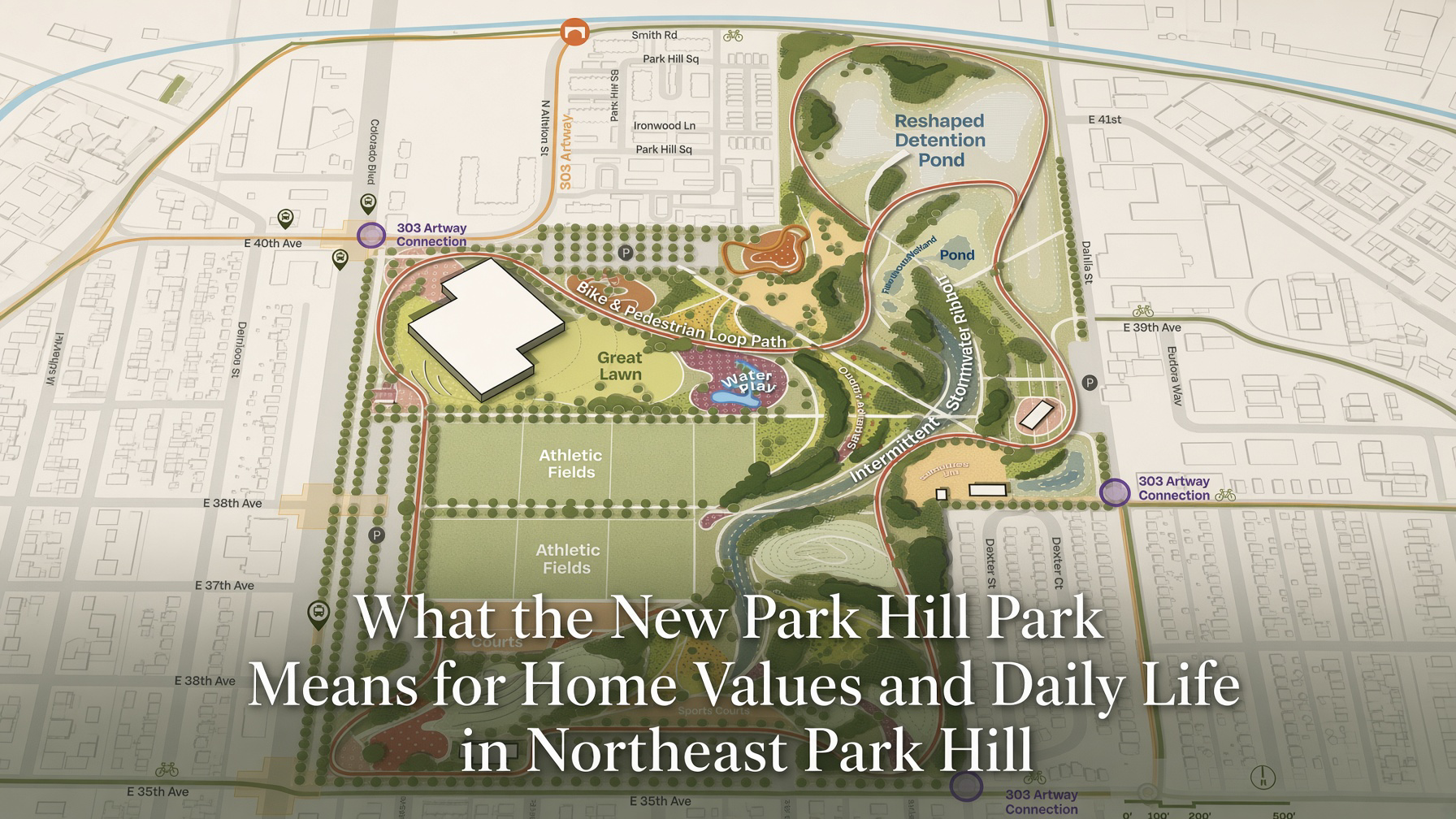
The current framework envisions a very different experience from the temporary park residents see today. Plans include athletic fields and courts, a destination playground, outdoor adventure areas, an aquatic experience, a field house, community gathering spaces, a renovated clubhouse, gardens, ecological features and a continuous multi-use loop through the property. Park Hill Park
The distinction is important for real estate.
A 155-acre park creates something that is difficult to reproduce in an established neighborhood: permanent open space at a regional scale. A homeowner does not have to worry about a developer eventually buying the adjacent vacant parcel and building 200 homes there.
That permanence is one of the most compelling aspects of the project from a long-term value perspective.
The park should create a value premium, but not a uniform one
Research generally supports a relationship between parks and residential property values, but the size of the premium depends heavily on the park itself and the property's exact location. A review of 33 U.S. studies found that proximity to parks generally increases property values, with larger parks producing benefits over greater distances. It also found that passive parks tend to generate larger premiums than heavily programmed recreational parks. Taylor & Francis Online
Denver-specific research makes the same point in a particularly useful way. A Trust for Public Land analysis estimated that homes within 500 feet of Denver parks received, on average, a 5% value contribution from proximity to parkland, while noting that the actual effect varies substantially based on park quality and the characteristics of the property. TPL Cloud
That 5% figure should not be applied mechanically to Northeast Park Hill homes. Park Hill Park is not yet a finished park, and there is no credible way to say today that a particular house will appreciate by a predetermined percentage because of it.
Instead, I would think about the value effect in layers:
| Location relative to park | Likely real-estate consideration |
|---|---|
| Directly facing the park | Potentially strongest amenity and view premium, but more exposure to activity |
| Within roughly 1 to 2 blocks | Strong combination of access and residential privacy |
| Several blocks away | Lifestyle benefit may remain, but direct value impact becomes harder to isolate |
| Adjacent to active facilities | Recreation access can be valuable, but noise, lighting and parking deserve scrutiny |
This is where neighborhood-specific real estate knowledge matters. The best property near a major park is not necessarily the one closest to it.
Why the best park-adjacent home may be one block away
The most interesting real estate opportunity around Park Hill Park may ultimately be the property that is close enough to use the park every day without having the park become its front yard.
Research has found that properties immediately adjacent to parks can sometimes receive a smaller premium than homes one or two blocks away when noise, traffic, lighting or parking become meaningful drawbacks. Taylor & Francis Online
That distinction could become particularly relevant here because the proposed park is designed to support both quiet and high-energy activities.
For example, a homeowner who wants to walk the park every morning, take a dog out after work and send children to a nearby playground may place a substantial premium on being within a five-minute walk. But that same buyer may not want a field house, athletic facility or event activity directly outside the bedroom window.
When I evaluate older Denver homes with buyers, I tend to separate access to an amenity from exposure to an amenity. They are not the same thing.
For Park Hill Park, that distinction could become a useful way to compare otherwise similar homes.
What could change about everyday life in Northeast Park Hill?
The biggest benefit of Park Hill Park may be measured in minutes rather than dollars.
The framework calls for a wide multi-use pathway system connecting the park, along with gathering areas, recreational facilities, natural landscapes and ecological features. The design also incorporates a meandering creek bed intended to manage stormwater while creating habitat, educational opportunities and visual interest. Park Hill Park
That changes the practical definition of the neighborhood.
A resident who currently drives elsewhere for organized sports, outdoor recreation or simply a large open space may eventually be able to accomplish those things within a few blocks of home. The park also creates a new east-west and north-south recreational connection across an area that historically had fewer major park amenities.
And there is an important social dimension. The planning process generated 7,765 completed surveys and 5,930 open-response comments, meaning the future park has been shaped by an unusually extensive community engagement process. Park Hill Park
That does not guarantee that every resident will agree with the final design. It does mean the park is emerging from a substantial neighborhood conversation rather than simply being imposed as a conventional redevelopment project.
Will Park Hill Park cause home prices to rise?
Probably, over the long term, but it is too early to assign a precise dollar premium to individual homes.
The first reason for caution is timing. The park is currently open, but today's experience is still essentially a temporary version of what is planned. Denver's current framework is a vision rather than a fully funded construction plan, and the city has acknowledged that not every proposed amenity has confirmed funding. Park Hill Park
The second reason is that real estate values respond to more than park acreage.
A buyer comparing two $900,000 homes in Northeast Park Hill will consider architecture, lot size, condition, floor plan, street traffic, parking, views, proximity to commercial areas and the character of the block. The park becomes one additional variable in that equation.
My expectation is that the biggest long-term benefit will accrue to homes that combine three characteristics:
- Walkable access to the park
- A pleasant residential setting
- Housing characteristics that already attract buyers
That third point is easy to overlook.
A spectacular park does not erase the difference between a thoughtfully renovated 1920s or 1930s home and a poorly renovated one. In a neighborhood with substantial older housing stock, the park can strengthen the location premium while architectural character, condition and renovation quality continue to determine how a particular property performs within its micro-market.
The bigger question is whether investment follows the park
For Northeast Park Hill, the park should be viewed as part of a larger neighborhood investment story rather than an isolated amenity.
Denver's own planning documents have identified needs around open space, housing, food access, transportation and small-business support in the area. The 2022 Small Area Plan, for example, called for at least 100 acres of parks and open space on the former golf course site and emphasized connections between the park and surrounding neighborhoods. Denvergov
That matters because neighborhoods become more valuable when multiple pieces reinforce one another.
A large park can increase the appeal of nearby homes. Better pedestrian connections can make the park more useful. Stronger neighborhood businesses can make walking to the park more meaningful. And investment in existing housing can determine whether longtime homes remain desirable as the neighborhood changes.
There is also a legitimate counterpoint: successful parks can contribute to displacement and "green gentrification." Denver has explicitly acknowledged that concern and has discussed affordable housing, displacement mitigation, small-business support and other measures around Park Hill Park. Denverite
That is why rising property values should not be treated as an uncomplicated measure of neighborhood success.
What should buyers and sellers watch over the next three years?
The most useful real estate strategy is to watch what is actually being built, not simply react to renderings.
The project has now reached an important milestone with the selection of Michael Van Valkenburgh Associates. Design work is expected to continue through 2027, with construction anticipated to begin in 2028 and completion targeted for 2029. Axios
For buyers, that creates an unusual opportunity. The neighborhood's future is becoming more visible, but the finished amenity has not yet been fully priced into every transaction.
For sellers, the opposite lesson applies. Simply saying "across from the future Park Hill Park" will not necessarily create a premium. The premium has to be demonstrated through the property's actual relationship to the park, its views, access, privacy and condition.
Having renovated older Denver homes myself, I also think the park changes the renovation equation. If a home is in a location likely to become more desirable over the next several years, preserving architectural character while improving the things buyers actually care about can make more sense than pursuing an expensive, generic renovation.
The key is to improve the house without spending as though every dollar will automatically be returned at resale.
Key Takeaways
- Park Hill Park is a major neighborhood amenity: At 155 acres, it will become Denver's fourth-largest park, making its scale materially different from a typical neighborhood park. Denver Park Trust
- The value impact should be positive but property-specific: Research supports a relationship between park proximity and home values, but premiums vary significantly based on distance, quality, amenities and neighborhood context. Taylor & Francis Online
- Closer is not always better: A home one or two blocks from the park may capture much of the lifestyle benefit while avoiding some of the noise, lighting and parking issues associated with being directly adjacent to active facilities.
- The next three years matter: Design work is expected through 2027, construction is currently targeted for 2028, and the city is aiming for completion by 2029. Axios
- The $70 million commitment makes the project more tangible: Voters approved $70 million in bond funding for the first phase, although the full buildout will require additional funding. Sasaki
- The park will not determine a home's value by itself: In Northeast Park Hill, architecture, lot size, renovation quality, block characteristics and the property's precise relationship to the park will continue to matter.
If you're interested in Denver real estate, neighborhood change, renovation or the long-term value of older homes, Let's connect.
If you're considering buying or selling in Northeast Park Hill, I can help you evaluate the opportunity at the property level, including how the park's future relationship to the home should influence pricing, renovation decisions and long-term value.
FAQ
Will Park Hill Park increase home values?
It is reasonable to expect the completed park to support residential values, but there is no defensible single percentage for Northeast Park Hill. Research generally finds positive park premiums, while also showing that distance, park quality and active uses can materially change the effect. Taylor & Francis Online
How big will Park Hill Park be?
The park encompasses 155 acres, making it Denver's fourth-largest park once developed. The scale is significant because it creates a large, permanently protected open-space amenity in an established urban neighborhood. Denver Park Trust
When will Park Hill Park be finished?
Denver currently expects construction to begin in 2028 and the completed park to open by 2029. Design work is expected to continue through 2027. Axios
What amenities are planned for Park Hill Park?
The framework includes athletic fields and courts, a field house, destination playground, outdoor adventure areas, an aquatic experience, natural areas, community gathering spaces, a renovated clubhouse and a multi-use pathway loop. Not every element is currently fully funded. Park Hill Park
Is it better to live directly next to the park or a few blocks away?
Not necessarily. Direct park frontage can provide views and immediate access, but homes one or two blocks away may offer a better balance of access, privacy and reduced exposure to activity, lighting and parking.
Should I buy a home in Northeast Park Hill because of the park?
The park should be treated as one part of the investment decision, not the entire thesis. A strong candidate would ideally combine convenient park access with desirable architecture, a good block, appropriate lot characteristics and a renovation budget that makes financial sense.
Could the park cause gentrification in Northeast Park Hill?
It could contribute to upward pressure on housing costs, which is why Denver has explicitly identified displacement and "green gentrification" as concerns surrounding the project. The city's planning efforts include measures intended to support affordability, existing residents and small businesses.
Check out this article next