


Summary
The best Denver renovations balance what a project costs, how much it improves daily life, and how future buyers will value the result. A $100,000 renovation that solves a major layout problem can be smarter than a $40,000 cosmetic update, while an expensive project that exceeds the neighborhood’s price ceiling can destroy value.
Renovating an older Denver home is rarely just a construction decision. It is a real estate decision, a lifestyle decision, and, whether homeowners intend it or not, a future resale decision.
That is particularly true in neighborhoods where the underlying house has something difficult to reproduce: architectural character, mature landscaping, larger lots, distinctive floor plans, or a location buyers already value. In those situations, the goal is not necessarily to make the house newer. It is to make the house work better without spending money in ways the next buyer will not recognize.
I think about that decision through three questions: What will it cost? What will it improve? What will the next buyer value?
The answers do not always point in the same direction.
Cost Is the First Filter, Not the Final Decision
A renovation should start with a realistic total project cost, but stopping there is one of the easiest ways to make a poor real estate decision. The cheaper project is not automatically the better investment if it leaves the fundamental problem unresolved.
Denver's older housing stock makes this especially important. A project that appears to be a straightforward kitchen or bathroom renovation can uncover electrical, plumbing, structural, drainage, or other conditions that change the scope. Denver's permitting guidance distinguishes simple projects such as painting, tiling, cabinet replacement and refinishing floors from work requiring more extensive review, while structural work cannot use the city's quick-permit path.
That creates an important rule: budget for the problem you are solving, not simply the finish you are buying.
For example, spending $35,000 on a cosmetic kitchen refresh may make sense if the kitchen already functions well. Spending $60,000 to $100,000 on a more substantial project may make more sense if the existing layout prevents the house from functioning for a modern family. Those figures are illustrative rather than universal project bids, because Denver construction costs vary dramatically by scope, materials and existing conditions.
The distinction matters because the first renovation may improve appearance while the second changes how the home actually lives.
Function Usually Creates More Durable Value
The strongest renovation decisions solve a problem that homeowners encounter every day. A better kitchen layout, a main-floor primary suite, improved storage, an additional bathroom, or a more useful connection between indoor and outdoor spaces can change the functionality of an older home without requiring the house to lose its identity.
This is one reason I am cautious about evaluating renovations strictly by percentage return. National Cost vs. Value data shows that large discretionary interior renovations often recover less at resale than homeowners expect. In the 2025 report, a minor kitchen remodel recouped 112.9% of its reported cost nationally, but the report also found that eight of its ten highest-return projects were exterior replacements. The lesson is not that every kitchen remodel is a great investment. It is that project type, scope and market context matter.
For an older Denver home, I would ask:
| Renovation question | Stronger case | Weaker case |
|---|---|---|
| Does it solve a daily problem? | Yes | Mostly cosmetic |
| Does it improve the floor plan? | Meaningfully | Marginally |
| Does it respect the home's architecture? | Yes | No |
| Does it fit neighborhood expectations? | Yes | Clearly overbuilt |
| Will buyers recognize the improvement? | Easily | Only with explanation |
That last question is particularly important.
A homeowner may spend $25,000 on something they love but receive little recognition for it from a buyer. Conversely, a relatively modest improvement to circulation, storage, natural light or bedroom functionality can become a major selling point because buyers immediately understand its benefit.
Resale Value Depends on the Buyer You Are Building For
A renovation becomes a real estate investment when you consider who is likely to buy the property after you. That does not mean designing a house for an imaginary future buyer. It means avoiding improvements so personal, expensive or unusual that they narrow the future market unnecessarily.
Denver's market is currently reinforcing that distinction. DMAR reported in June 2026 that buyers were increasingly prioritizing move-in-ready homes and becoming more conscious of the cumulative cost of ownership over five to ten years.
That makes the third side of the triangle increasingly important: resale is not simply about whether the renovation looks good. It is about whether the buyer sees enough value to justify the price.
Consider two hypothetical $150,000 renovations.
One creates a highly customized entertainment space with finishes that appeal to a very specific aesthetic. The other reorganizes a cramped first floor, adds a functional bathroom, improves storage and restores architectural details that had been removed.
The second renovation may have a broader buyer audience even if the first renovation photographs beautifully.
This is where Denver neighborhood knowledge becomes valuable. A renovation that makes sense in a large Wash Park home may not make sense in a smaller Congress Park property. A design decision appropriate for a newer Central Park house may feel completely disconnected from a 1910s Park Hill bungalow.
The house, lot, architecture and surrounding price range establish boundaries around what "better" actually means.
Older Denver Homes Require a Different Kind of Renovation Judgment
With older homes, the highest-value improvement is sometimes the one you do not make.
Denver has neighborhoods where original woodwork, fireplaces, windows, trim, built-ins, brickwork and distinctive floor plans contribute meaningfully to the home's identity. Removing those elements in pursuit of a generic contemporary aesthetic can solve one problem while creating another.
I have renovated older Denver homes myself, and one lesson that has stayed with me is that old houses often reward selective intervention. The objective is not to preserve every awkward feature. It is to determine which characteristics create value and which characteristics prevent the house from functioning well today.
There is also a practical Denver consideration: historic designation can affect the renovation process. Denver's rules require zoning permits for alterations to designated preservation properties and properties within designated preservation districts in certain circumstances, while exterior work on designated historic buildings can require Landmark review and a Certificate of Appropriateness.
That means a renovation budget should account for more than construction.
Before buying an older home, I would want to understand:
- What is architecturally valuable?
- What is functionally obsolete?
- What infrastructure needs attention?
- What can realistically be changed?
- What will the finished property compete against when it eventually sells?
That fifth question is where renovation and real estate strategy intersect.
The Best Renovation Often Sits Between "Too Little" and "Too Much"
Denver homeowners can make two opposite mistakes. They can spend too little to solve the fundamental problem, or spend too much creating a house that sits above what buyers will pay for the location.
The second risk is particularly difficult because the renovation itself can be excellent.
Imagine a $900,000 home in a neighborhood where renovated comparable properties generally sell around $1.2 million. Spending $150,000 to improve the property may be sensible. Spending $400,000 may produce a beautiful house but leave the owner with a $1.3 million cost basis in a market where buyers still see the location as a $1.2 million proposition.
That is the difference between renovation quality and renovation economics.
The calculation should therefore look something like this:
Current value + renovation cost ≠ guaranteed future value.
Instead, ask whether the renovation moves the property into a more valuable competitive category.
DMAR's August 2026 report is a useful reminder of why this matters. The market is not behaving as one uniform market, and buyers remain discerning about individual properties and their condition.
In practical terms, I would rather see a homeowner spend $100,000 strategically than $150,000 indiscriminately.
Think Like an Owner, Then Think Like a Buyer
The best renovation decisions start with your own life but end with an understanding of the market.
If you expect to live in the house for ten years, a renovation that dramatically improves your family's daily experience can be worthwhile even if it does not return every dollar at resale. Zonda's 2025 research makes a similar distinction, noting that interior projects can make more sense for owners staying longer, while exterior replacement projects have tended to produce stronger resale returns nationally.
But if you expect to sell in three years, the calculation changes.
A useful rule is to separate renovation dollars into three buckets:
Must do: Problems involving safety, water, structure, major systems or functionality.
Should do: Improvements that materially improve how the home lives and align with buyer expectations.
Nice to have: Personal preferences that improve enjoyment but are unlikely to materially change the property's competitive position.
The first category protects value. The second can create value. The third primarily creates lifestyle value.
There is nothing wrong with the third category. The mistake is confusing it with an investment.
The Real Goal Is Better Value, Not Maximum Renovation
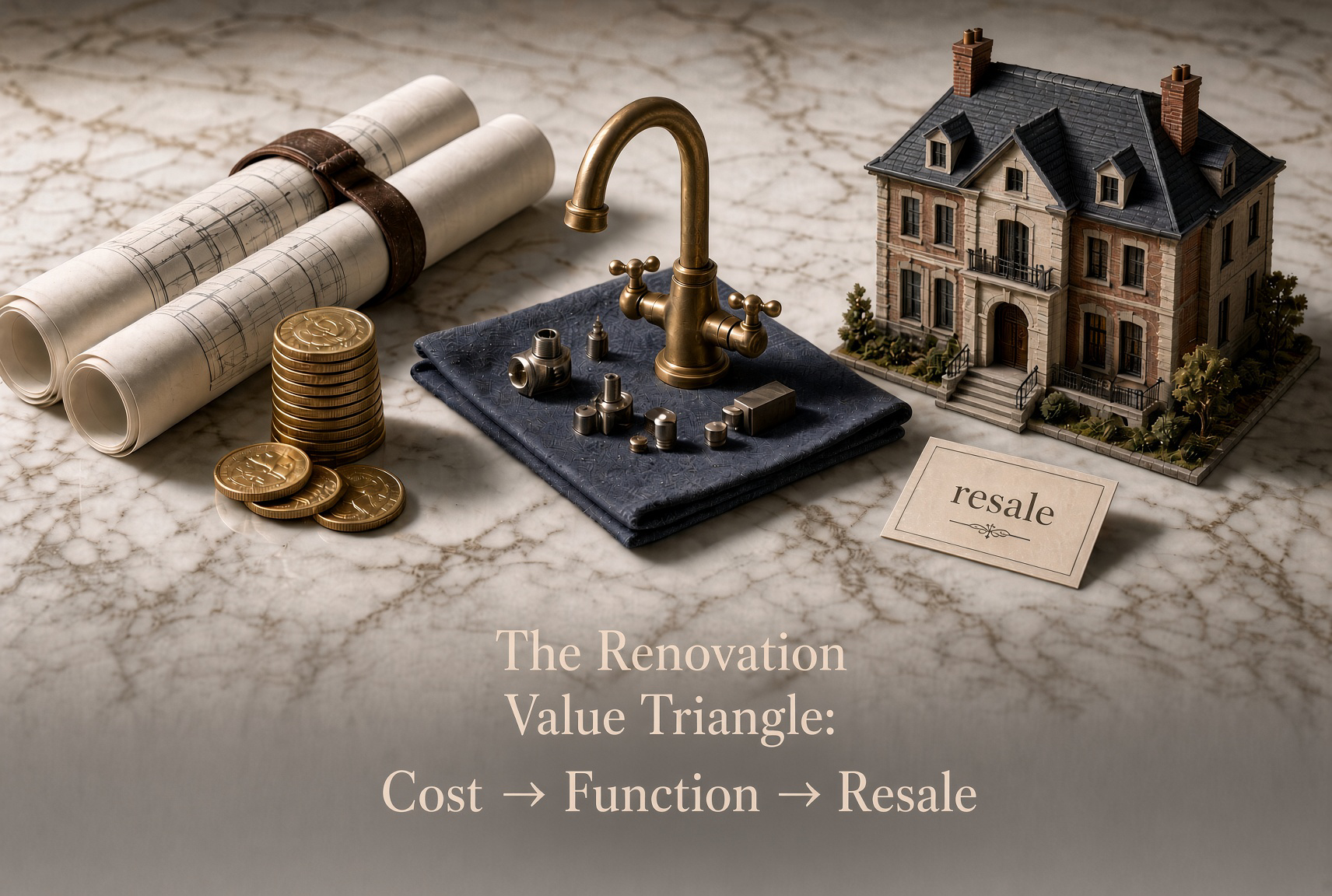
Renovation value in Denver is ultimately about balance. Cost tells you what you are risking. Function tells you what you gain while you own the house. Resale tells you how much of that investment the future market may recognize.
For buyers considering an older Denver home, that framework can be particularly useful because the renovation opportunity is often part of the property's appeal. The right question is not, "How much would it cost to make this house perfect?"
It is, "What does this house need to become significantly better without spending beyond what the location, architecture and future buyer can support?"
That is a very different question.
And in neighborhoods such as Park Hill, Congress Park, Washington Park, Alamo Placita and other areas with distinctive older housing stock, that distinction can determine whether a renovation becomes a long-term asset or an expensive personal project.
If you're thinking about renovating an older Denver home and want to compare the construction decision with the real estate implications, Let's connect. I enjoy helping homeowners think through the intersection of architecture, function, cost and long-term value before they commit to a project.
The smartest renovation is rarely the one with the biggest budget. It is the one that solves the right problem, fits the house and neighborhood, and leaves you with a property that both you and the next buyer can understand the value of.
Key Takeaways
- Cost is only the first test. A lower-cost cosmetic renovation can be less valuable than a larger project that solves a fundamental layout or functionality problem.
- Function often creates broader value than personalization. Improvements to kitchens, bathrooms, storage, circulation and bedroom functionality are easier for future buyers to recognize.
- Denver's older homes require architectural judgment. Original details can contribute to a property's identity and should not automatically be sacrificed for contemporary finishes.
- Know the neighborhood's price ceiling. A $150,000 renovation can make sense on a property with substantial upside, while a much larger project can create an over-improved home.
- Time horizon changes the calculation. A homeowner planning to stay ten years can reasonably prioritize lifestyle benefits differently from someone expecting to sell within three years.
- Think about the future buyer before construction begins. Resale value depends on how the finished property compares with the alternatives buyers will have at the time of sale.
FAQ
What is the renovation value triangle?
The renovation value triangle considers cost, function and resale together. A project is strongest when its cost is reasonable, its improvement to daily life is meaningful, and future buyers are likely to recognize the resulting value.
How much should I spend renovating an older Denver home?
There is no universal percentage that works for every Denver property. A better starting point is to compare the home's current value, likely post-renovation value, neighborhood price range and competing renovated properties before establishing a renovation budget.
Do kitchen renovations pay off when selling a Denver home?
They can, but the return depends heavily on scope and market position. National 2025 Cost vs. Value data reported a 112.9% cost recoupment for a minor kitchen remodel, but that figure should not be treated as a Denver-specific prediction for a particular property.
Should I preserve original details in an older Denver home?
Often, yes, particularly when those details contribute to the property's architectural identity. The better question is whether an original feature is valuable character or a genuine functional problem that prevents the house from meeting modern needs.
How do I avoid over-improving a Denver home?
Compare the proposed finished value with recent comparable properties and the upper end of the neighborhood's market. If your projected cost basis moves substantially beyond what buyers have historically paid for similar homes nearby, the renovation deserves closer scrutiny.
Does historic designation affect renovation decisions in Denver?
It can. Certain alterations to designated historic properties or properties in historic districts can require zoning or Landmark Preservation review, so buyers should determine the property's status before finalizing a renovation plan.
Is a renovation still worthwhile if I do not recover all of the cost at resale?
Yes. If you plan to own the home for several years, part of the return can come from improved daily life rather than resale proceeds. The important distinction is knowing whether you are making a lifestyle purchase, a value-enhancing investment, or a combination of the two.
Check out this article next