

Summary
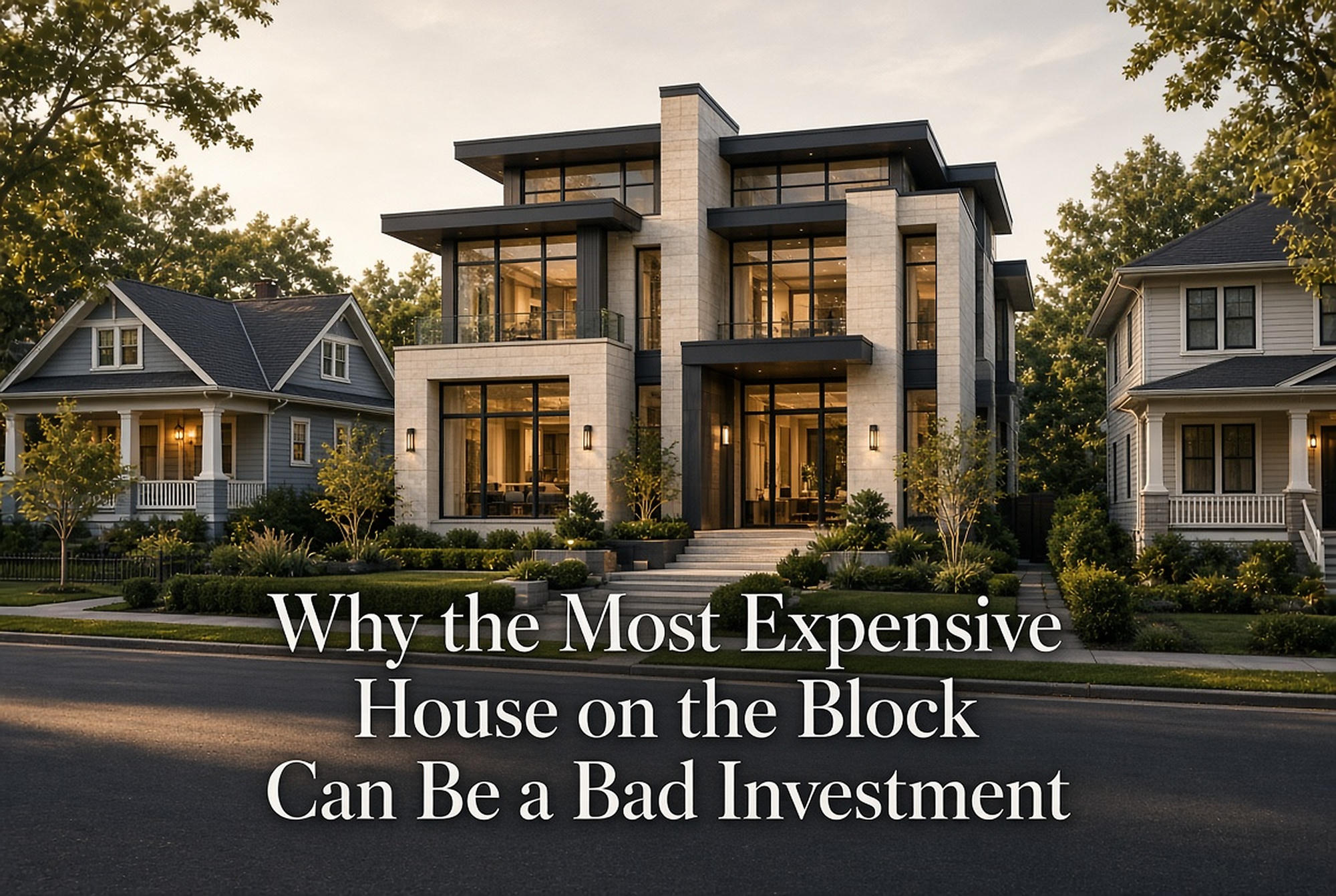
The most expensive house on the block can be a poor investment when its price exceeds what buyers in that micro-market will support. In Denver, paying a premium for superior architecture, lot size, or renovation quality can make sense, but paying substantially more than nearby comparable homes can create appraisal, resale, and buyer-pool risk.
A high price is not automatically a problem. The problem is paying for value that the next buyer may not recognize.
That distinction matters more in Denver's older neighborhoods, where one block can contain dramatically different houses, lot sizes, architectural styles, additions, and renovation quality. A 1910 Denver Square with original woodwork and thoughtful updates does not necessarily compete with a newly built home down the street simply because both have four bedrooms. Likewise, a spectacular renovation can justify a premium, but only to the extent that buyers in that particular micro-market are willing to pay for it.
The investment question, therefore, is not simply, "Is this the nicest house on the block?" It is, "How much of what I am paying will still be valuable to the next buyer?"
The Most Expensive House Is Not Necessarily the Most Valuable House
The most expensive house on a block becomes risky when its price is driven more by what the current owner values than by what the surrounding market supports. A useful rule is to ask whether the premium is explained by durable attributes such as land, architecture, location, layout, and quality of construction, or by expensive improvements that future buyers may value differently.
This is particularly important in Denver's older neighborhoods.
A larger lot, superior original architecture, a better street location, or a well-designed addition can create genuine scarcity. Those characteristics are difficult for another homeowner to replicate. A $200,000 kitchen renovation, by contrast, does not automatically create $200,000 of additional market value.
That does not mean expensive renovations are bad investments. It means the relationship between cost and contributory value matters.
For example:
| What creates the premium | Investment implication |
|---|---|
| Larger or unusually useful lot | Often durable because supply is fixed |
| Superior architectural character | Can command a premium with the right buyer |
| Better layout | Valuable if it solves a common buyer objection |
| Added functional square footage | Stronger when it changes the home's category |
| High-end finishes | Valuable only if buyers in that price range expect them |
| Highly personalized design | Greater resale risk if the buyer pool is narrow |
In Denver, this distinction is especially relevant because the market is not moving as one homogeneous group. DMAR reported that the overall median close price in August 2026 was $594,495, while the $1 million-plus market continued to behave differently from the broader market. Detached luxury homes averaged 47 days in the MLS, compared with 99 days for attached luxury properties.
The lesson is simple: price creates a different buyer pool, and a different buyer pool has different expectations.
The Real Risk Is the Price Ceiling
Every neighborhood has a practical price ceiling, even if that ceiling is not written anywhere. The ceiling is the level at which buyers begin comparing a property against fundamentally different alternatives rather than simply against neighboring homes.
This is where the most expensive house on the block can become vulnerable.
Imagine a renovated older home priced at $1.6 million in a neighborhood where most comparable sales fall between $1.1 million and $1.35 million. The house may genuinely be better than those properties. But at $1.6 million, buyers may no longer compare it only with nearby houses. They may consider a larger lot, newer construction, a different neighborhood, or a property requiring less work.
That changes the competitive set.
I often think about this as the next-door test: if you are paying a substantial premium over nearby homes, what would make the next buyer choose yours instead of spending the same money somewhere else?
The answer should be more compelling than "because the finishes are nicer."
In Denver, this matters even more in a market where buyers have become more selective. DMAR reported that median days in the MLS increased from 21 in July to 27 in August 2026, while the median close price remained essentially flat year over year.
When buyers have more time and more choices, pricing mistakes become easier to expose.
A Better Way to Think About Renovation ROI
The best renovation investment is rarely the renovation with the highest price tag. It is the improvement that solves an important problem while moving the property into a stronger competitive category.
Having renovated older Denver homes myself, I have learned that the most valuable improvements are often the ones that change how a buyer experiences the house rather than simply making individual rooms more expensive.
A poorly configured first floor, for example, can limit the buyer pool. Creating a functional main-floor primary suite may be far more consequential than installing another $40,000 of luxury finishes in a kitchen that was already attractive.
The same principle applies to historic homes.
Preserving original hardwood floors, distinctive millwork, fireplaces, tile, doors, or architectural proportions can create something that new construction cannot easily reproduce. But the value comes from combining character with function. A beautiful 1910 house with an awkward layout and obsolete systems may still struggle against a well-renovated competitor.
A useful renovation test is:
Will this improvement increase the number of buyers who would choose this house, or merely increase the amount one particular buyer might spend?
The first is usually stronger.
Why Denver's Older Neighborhoods Make This More Complicated
Denver's older neighborhoods are unusually sensitive to the relationship between architecture, lot, condition, and price because the housing stock varies so dramatically from property to property.
In Park Hill, Congress Park, Washington Park, Alamo Placita, and other established neighborhoods, two houses a few blocks apart can have completely different investment characteristics. One might have original architectural details and a 7,000-square-foot lot. Another might have been substantially altered over time. A third might have been scraped and replaced with new construction.
Treating all three as interchangeable because they have similar bedroom counts is a mistake.
The house with the best architecture may deserve a premium. The house with the best lot may deserve a premium. The house with the best renovation may deserve a premium. But those premiums need to be evaluated separately.
This is one reason I pay close attention to the micro-market, not simply the neighborhood average.
A neighborhood median can tell you where the market is generally moving. It cannot tell you whether a particular 1920s Tudor with a 5,000-square-foot lot should trade at the same level as a substantially larger home on a 7,500-square-foot lot.
When Paying the Most Actually Makes Sense
Being the most expensive house on the block is not inherently dangerous. It can be an excellent purchase when the premium is supported by attributes that are scarce, difficult to reproduce, and likely to remain desirable.
I would be much more comfortable paying a premium when the house has several of these characteristics:
- Exceptional location within the neighborhood
- A meaningfully superior lot
- Distinctive architecture
- Functional square footage that competing homes lack
- High-quality renovation rather than purely cosmetic upgrades
- Strong condition and updated major systems
- A design that appeals to a broad segment of buyers at that price
The more of these factors that exist, the easier it is to defend a premium.
The opposite is also true. If the premium is primarily attributable to designer finishes, highly customized spaces, or an unusually high renovation budget, I become more cautious.
The question is not whether the house is impressive. It is whether the house is defensibly impressive at that price.
The Next Buyer Is Part of Your Investment Thesis
Real estate is unusual because you do not need to sell today for the next buyer to matter today.
When I evaluate a high-priced property, I try to imagine the eventual resale conversation. Who is likely to buy this house? What will they compare it against? What objection will they have to paying the premium?
That exercise is particularly important above $1 million because the buyer pool becomes narrower. DMAR's 2026 data shows that the $1 million-plus market remains active, but properties are taking longer to sell than during the frenzy of 2021 and 2022. In March, the segment had a median of 21 days in the MLS versus just 4 days in 2022.
A narrower buyer pool does not mean a property cannot sell. It means positioning, pricing, condition, and differentiation become increasingly important.
The best investment is therefore not necessarily the house everyone admires.
It is the house whose price can be explained logically to the next buyer.
A Simple Test Before Paying a Premium
Before buying the most expensive house on the block, I would want five questions answered:
| Question | What you are testing |
|---|---|
| What makes this house better? | Genuine differentiation |
| How much of the premium is land or architecture? | Durable value |
| How much is renovation cost? | Potential over-improvement |
| What alternatives exist at the same price? | Competitive risk |
| Who is the next buyer? | Future liquidity |
If the answers are compelling, paying more can be completely rational.
If the answer to most questions is simply "because it has nicer finishes," I would slow down.
That is particularly true in today's Denver market. August's overall median price was essentially unchanged from a year earlier, while homes took a median 27 days to sell. The market is rewarding properties that give buyers a clear reason to choose them, not simply properties that cost the most to create.
The Best House on the Block Is Often the One With the Best Value Story
The strongest real estate investments are rarely about being the cheapest house or the most expensive house. They are about buying something where the relationship between price and underlying value makes sense.
For older Denver homes, that often means finding the combination of architecture, lot, location, layout, condition, and renovation quality that gives the property a defensible position within its micro-market.
That is also why I believe buyers should evaluate expensive homes differently from ordinary comparables. A high price demands a higher standard of evidence.
If you are paying a premium, you should be able to explain exactly what you are buying with that premium.
And if you cannot explain it, there is a good chance you are simply paying for someone else's renovation decisions.
If you're interested in Denver real estate, older homes, renovation strategy, and the financial decisions behind buying well, Let's connect.
If you are evaluating a home that sits at the top of its neighborhood's price range, I can help you separate the features that create durable value from the improvements that may be difficult to recover at resale.
Key Takeaways
- Being the most expensive house on the block is not automatically a bad investment. The risk increases when the premium cannot be explained by scarce, durable attributes such as land, architecture, location, or functional square footage.
- The practical price ceiling matters. Once a home moves substantially above nearby comparable sales, buyers may begin comparing it with entirely different neighborhoods, newer construction, or larger properties.
- Renovation cost is not the same as renovation value. A $200,000 renovation does not automatically add $200,000 to resale value. Improvements that solve functional problems generally have a stronger investment case than purely cosmetic upgrades.
- Denver's older neighborhoods require micro-market analysis. Two houses in Park Hill or another historic neighborhood can have materially different value because of lot size, architecture, condition, layout, and renovation quality.
- The next buyer should be part of today's decision. A $1 million-plus property has a narrower buyer pool than a $600,000 home, making pricing, condition, and differentiation increasingly important.
- A premium should have a reason. Before paying more, identify exactly what makes the property better and whether that advantage is likely to remain valuable five or ten years from now.
FAQ
Is the most expensive house on the block always a bad investment?
No. It can be an excellent investment when the premium is supported by scarce attributes such as an exceptional lot, architecture, location, or functional layout. The concern is paying substantially more without a defensible reason.
How much more should I pay for a better house?
There is no universal percentage. Compare the premium against specific differences in lot size, finished square footage, architecture, condition, systems, renovation quality, and location rather than applying a blanket rule such as 10% or 20%.
Can a high-end renovation increase a home's value?
Yes, but renovation cost and market value are different measurements. A renovation is more likely to create durable value when it improves function, corrects significant deficiencies, or moves the home into a price category where buyers expect that level of finish.
Why is the most expensive house harder to resell?
The higher the price, the smaller the potential buyer pool generally becomes. In Denver's $1 million-plus market, DMAR reported a 21-day median in the MLS in March 2026, compared with just 4 days in 2022, illustrating how much more patient today's higher-end market can be.
Does this principle apply to Park Hill?
Yes, particularly because Park Hill contains varied housing stock, lot configurations, architectural styles, and renovation levels. A renovated historic home should not automatically be valued against every other four-bedroom property nearby.
Should I avoid buying a home above the neighborhood average?
No. Neighborhood averages can conceal major differences between properties. A better question is whether the premium is supported by characteristics that future buyers are likely to recognize and pay for.
What is the biggest mistake buyers make with expensive homes?
The biggest mistake is confusing a home's cost with its value. If a property is expensive because the owner spent heavily on highly personal improvements, the next buyer may not assign the same value to those improvements.
Check out this article next