

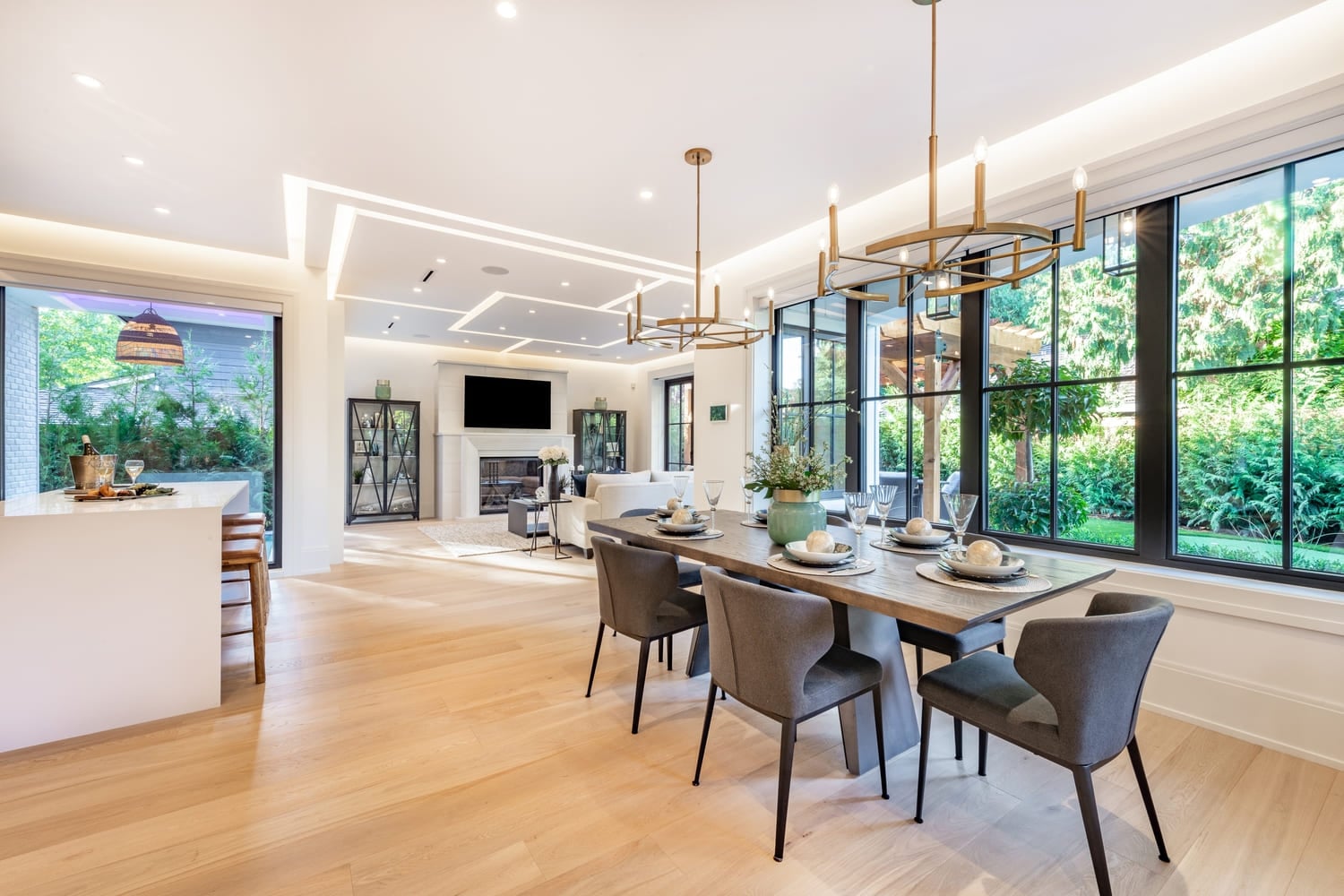


For years, American home design seemed to be moving in one direction: newer, cleaner, simpler, and increasingly interchangeable.
White kitchens. Neutral walls. Modern light fixtures. Wide-plank floors. Marble-look countertops. The same handful of finishes repeated from one newly renovated home to the next.
But something has changed.
Increasingly, homeowners and designers are looking for something that cannot be manufactured quite so easily: character.
That shift is particularly evident in the growing influence of English interior design, where old and new have traditionally been allowed to coexist. Instead of stripping away a home's history, English design often celebrates it. Instead of trying to make every room look perfectly coordinated, it embraces collected objects, unusual patterns, antique furniture, beautiful materials, and the occasional imperfection.
Brands such as deVOL Kitchens and House of Hackney have helped bring this sensibility to a much broader American audience. Their work draws heavily from historic interiors, antique furniture, Victorian patterns, traditional craftsmanship, and materials that develop character over time.
The result is not simply a new decorating trend. It reflects a larger change in what people want their homes to feel like.
And as someone who has spent years buying, renovating, and selling older homes in Denver, I think this is particularly interesting for homeowners here.
The end of the cookie-cutter interior
There is nothing inherently wrong with a beautiful new kitchen or a carefully renovated bathroom.
The problem begins when every house starts looking like the same house.
One of the things I have learned from renovating older Denver homes is that the most successful projects rarely begin with the question, "What is everyone else doing?"
Instead, the better question is:
What makes this particular house special, and how can we make more of it?
That might be original millwork. A beautiful staircase. An unusual floor plan. Historic windows. A fireplace. Old-growth wood floors. A distinctive roofline. Or simply the proportions and details that give an older house its personality.
Rather than erasing those characteristics in the name of modernization, thoughtful design can make them the starting point.
That philosophy is at the heart of much of the English design aesthetic.
What is the English design influence?
English interiors have historically been much more comfortable with mixing periods, materials, colors, and styles.
A Victorian house might contain a contemporary sofa. An antique dining table might sit beneath a modern light fixture. A room might combine wallpaper, painted cabinetry, patterned upholstery, brass hardware, and inherited furniture without everything matching.
There is a sense that a home should look assembled over time rather than purchased all at once.
That distinction matters.
A curated room feels personal. A coordinated room can feel like a showroom.
The difference is not necessarily how much money was spent. It is whether the objects, materials, colors, and architectural elements have a reason for being there.
Why brands like deVOL and House of Hackney matter
The influence of this aesthetic is easy to see in the work of brands such as deVOL Kitchens and House of Hackney.
deVOL has helped popularize a kitchen aesthetic that feels rooted in historic English homes rather than contemporary showroom design. Its kitchens often incorporate traditional cabinetry, natural materials, aged finishes, and details that feel intentionally individual rather than mass-produced.
House of Hackney takes a similarly historical approach through pattern, color, and textiles. Its work draws inspiration from Victorian interiors and historic botanical and decorative motifs, but reinterprets them in a way that feels contemporary.
What both demonstrate is important: historical inspiration does not have to mean historical imitation.
You can borrow from the past without creating a period museum.
That is where I think the trend gets particularly interesting.
Beautiful materials are replacing perfect materials
Another major shift is happening in the way people think about materials.
For a long time, "high end" often meant perfectly uniform. Stone without variation. Wood without knots. Finishes without visible imperfections.
Now, there is growing appreciation for materials that have their own personality.
Natural stone with variation. Handmade tile. Aged brass. Patterned wallpaper. Painted cabinetry. Reclaimed wood. Textiles with texture.
These materials are interesting because they change.
They develop patina. They interact with light differently. They show evidence of craftsmanship. They are less likely to look exactly the same in another house.
That individuality is becoming part of the appeal.
And there is a practical lesson here for homeowners considering a renovation: the most expensive material is not necessarily the material that creates the most value.
A thoughtful combination of materials with texture, history, and visual interest can often make a home feel considerably more special than an expensive collection of generic finishes.
Why this matters in Denver's older homes
Denver is particularly well positioned for this movement because the city has an extraordinary collection of older housing stock.
Neighborhoods such as Park Hill, Congress Park, City Park West, Washington Park, Country Club, Berkeley, West Highland, Sloan's Lake, and others contain homes with architectural identities that were established long before today's design trends.
That creates an interesting opportunity.
When I walk through an older Denver home with a buyer, I am not only looking at what the house is today. I am also thinking about what makes the house itself distinctive.
Where is the original character?
What has already been changed?
What could be restored?
Where would an addition make sense?
And perhaps most importantly, where should we resist the temptation to make the house look like every other renovated property?
This matters for buyers because the most interesting older homes often require a different way of thinking about value.
A home with original architectural character may not have the most immediately "Instagrammable" kitchen. But that does not mean it lacks potential.
In fact, its architectural character may be one of its greatest long-term assets.
The best renovations do not make old homes look new
This is one of my strongest opinions when it comes to renovating Denver's older homes.
A successful renovation should make an old house function better, not necessarily make it look new.
There is a difference.
A 1920s Denver home can have a beautifully updated kitchen without pretending it was built in 2026. A historic bathroom can gain modern plumbing and functionality without losing its sense of place.
The goal is not to freeze a house in time.
It is to create a home where the architecture, materials, furnishings, and modern conveniences feel like they belong together.
That is where thoughtful interior design becomes more than decoration. It becomes part of the home's overall value proposition.
What does this mean for Denver homeowners?
If you are renovating a historic or older Denver home, I would encourage you to think beyond resale trends.
Start with the house.
Look at its architecture. Understand when it was built. Identify the details worth preserving. Think about how the original designers intended the rooms to relate to one another.
Then consider where contemporary design can improve the way you live.
Sometimes that means opening up a kitchen. Sometimes it means adding square footage. Sometimes it means restoring rather than replacing.
And sometimes it means making a bold design decision.
I have seen homeowners become so focused on making a renovation "safe" that they remove the very characteristics that could have made the finished home memorable.
The irony is that a home designed to appeal to everyone can sometimes end up appealing to no one particularly strongly.
A home with a clear point of view can be much more compelling.
Authenticity may become one of the most valuable design features
There is a larger lesson here for Denver real estate.
As more homes are renovated, buyers have more opportunities to compare them. That makes differentiation increasingly important.
A beautifully renovated home is no longer automatically unusual.
The homes that stand out are often the ones where someone has thought carefully about the relationship between architecture, design, materials, landscaping, and neighborhood.
That does not mean every home needs wallpaper and antique furniture.
It means the renovation should feel intentional.
For buyers, this is one reason I encourage looking beyond the surface when evaluating an older Denver property. A house that has not yet been renovated may actually offer more opportunity to create something distinctive than one that has already been remodeled according to the prevailing template.
For sellers, it is equally important. Before investing in another round of generic improvements, ask whether the renovation is actually adding character and differentiation or simply making the house more similar to its competition.
The future of American interiors may look a lot like the past
Perhaps the most interesting thing about the English design influence is that it is not really about going backward.
It is about recognizing what we may have lost by moving too far toward uniformity.
Character. Craftsmanship. Patina. Pattern. Individuality. History.
The future of great American interiors may not be minimalist or maximalist, traditional or contemporary.
It may simply be personal.
And in a city like Denver, where some of the most interesting homes were built generations ago, that is an exciting development.
One of the reasons I enjoy working with older homes is that every property presents a different design puzzle. The challenge is not simply figuring out how to make a house more valuable. It is figuring out how to make the improvements feel like they belong.
That is often where the greatest opportunities are found.
If you are considering buying, selling, or renovating an older Denver home, David Krohne and the FORM Team at Compass Denver can help you think through not only the real estate transaction, but also the architectural, renovation, and market considerations that can influence a property's long-term appeal.
Key Takeaways
- American interiors are moving away from uniformity and toward individuality, with growing appreciation for character, history, pattern, and curated spaces.
- English design is influencing this shift by demonstrating how antique furniture, Victorian patterns, traditional craftsmanship, and modern pieces can coexist successfully.
- Materials with natural variation and character are becoming more desirable, including handmade tile, natural stone, aged metals, textured textiles, and other finishes that do not look mass-produced.
- Denver's older homes are particularly well suited to this approach because their original architecture can provide a strong foundation for thoughtful renovation.
- The best renovation does not necessarily make an older home look new. It improves functionality while preserving and reinforcing the qualities that make the property distinctive.
- For buyers and sellers, authenticity can become a competitive advantage. A home with a clear architectural and design identity can stand apart from properties renovated according to the same generic formula.
Frequently Asked Questions
Why is English interior design becoming popular in America?
English interiors offer an alternative to highly coordinated, contemporary spaces. They embrace character, historic references, layered materials, pattern, antique furniture, and rooms that feel collected over time.
What is the difference between curated and coordinated interior design?
A coordinated room is designed around a consistent set of finishes, colors, and furnishings. A curated room can combine different periods, materials, patterns, and objects while still feeling intentional and cohesive.
Is English design appropriate for a modern Denver home?
Absolutely. The goal is not to recreate an English country house. Elements such as traditional cabinetry, patterned wallpaper, antique furniture, natural materials, and vintage-inspired lighting can be incorporated into contemporary homes without making them feel historically themed.
Should you preserve original features when renovating an older Denver home?
In many cases, yes. Original architectural details can be among a home's most distinctive characteristics. The right decision depends on the condition of the feature, the home's architecture, the renovation goals, and the overall property.
Does an expensive renovation automatically increase a home's value?
No. Cost and value are not the same thing. Renovations that improve functionality, respect the home's architecture, and differentiate the property from competing homes can be more valuable than simply selecting expensive finishes.
Why are Denver's historic homes well suited to this design trend?
Older Denver neighborhoods contain homes with distinctive architectural details, proportions, materials, and layouts. Those characteristics can provide a foundation for renovations that feel more personal and less interchangeable.
Should sellers renovate before putting an older Denver home on the market?
Not necessarily. The best strategy depends on the property, its condition, the likely buyer, competing inventory, and the cost of the proposed improvements. Sometimes a thoughtful renovation makes sense. In other situations, preserving the home's existing character and pricing it accordingly can be the better strategy.
Check out this article next
