

Summary
In 2026, South Park Hill generally commands the highest prices, North Park Hill offers a middle ground with strong architectural character, and Northeast Park Hill provides the lowest entry point. The tradeoff is not simply price: buyers are choosing among different housing eras, lot characteristics, renovation opportunities, walkability, and long-term value considerations.
Park Hill is often discussed as though it were a single real estate market. It is not.
Greater Park Hill is officially divided into South Park Hill, North Park Hill, and Northeast Park Hill, with 23rd Avenue separating South from North and Martin Luther King Jr. Boulevard separating North from Northeast. The three areas share a broader identity, but the experience of buying a house in each can be meaningfully different.
That distinction matters in 2026 because buyers have more negotiating room than they did during the most competitive years of the market. Denver ended September with 13,567 active listings and 4.76 months of inventory, while the median detached-home close price was $635,000. Mortgage rates were also around the 7% range, making the relationship between purchase price, condition and future renovation costs especially important.
For a buyer considering Park Hill, the better question is therefore not "Which section is cheapest?" It is "What am I getting for the additional dollars, and which compromises am I actually making?"
South Park Hill generally offers the strongest combination of architecture, location and established housing stock
South Park Hill is the premium end of the three-part comparison, particularly for buyers who place a high value on historic character, proximity to City Park and the established residential environment along streets such as Montview Boulevard and 17th Avenue Parkway.
The most recent Realtor.com neighborhood snapshot, through August 2026, puts the median sold price at $926,500, with a median listing price of $812,450 and median days on market of 37. That sold-price figure is influenced by the mix of homes that actually traded, so it should not be interpreted as meaning every South Park Hill house is worth nearly $1 million.
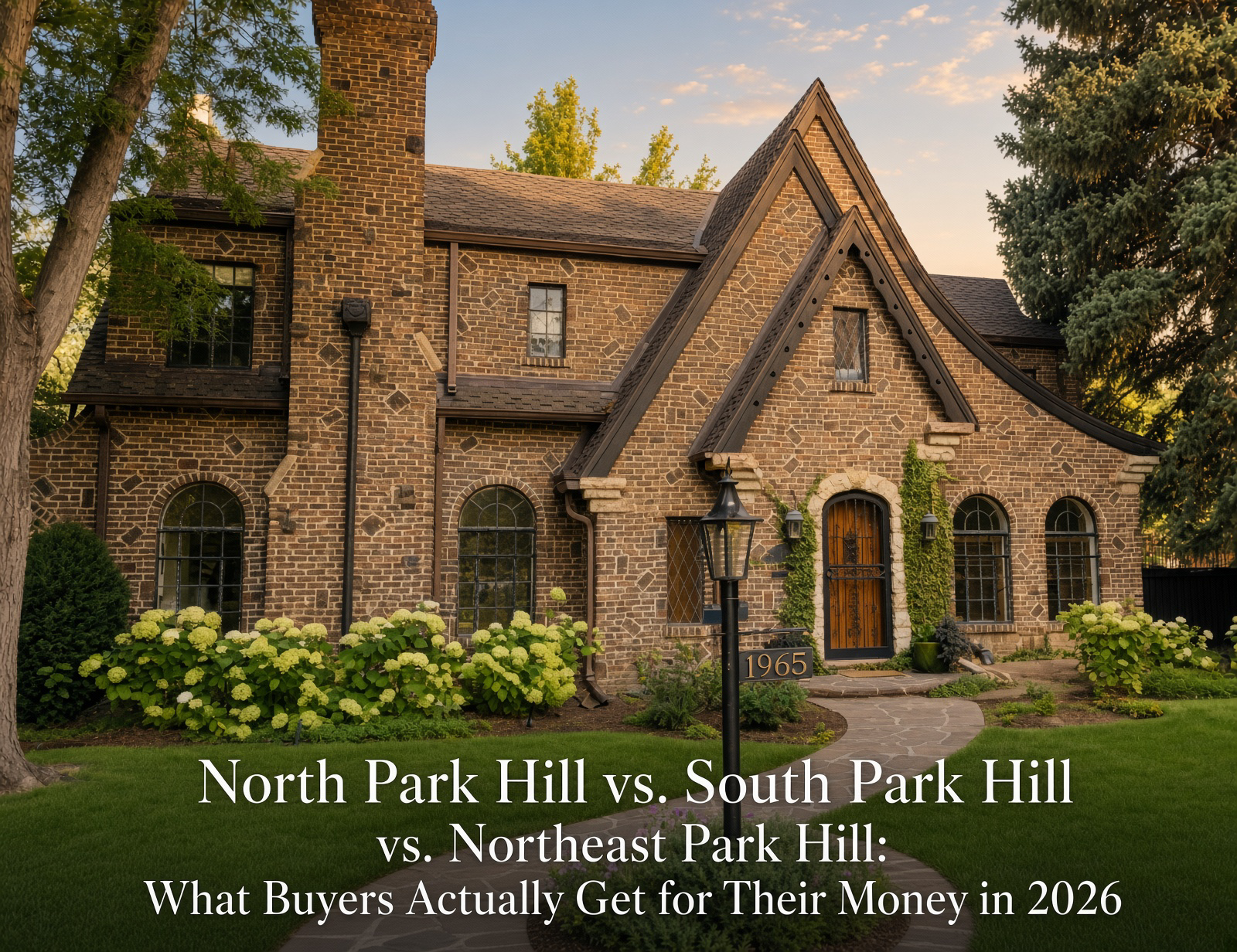
What buyers are paying for is partly the housing stock itself. South Park Hill contains some of Greater Park Hill's most architecturally distinctive homes, including Foursquares, Arts and Crafts, Tudor Revival, French Eclectic and Colonial Revival examples. The neighborhood also contains historic parkways and mature streetscapes that contribute to its appeal beyond the individual house.
This creates a particular buyer profile: someone who wants an older Denver house with architectural character and is willing to pay more to get it in a highly established setting.
For a buyer with a $900,000 budget, for example, South Park Hill may offer an older home in need of selective work rather than a fully renovated property. The same budget can buy a substantially different house farther north.
North Park Hill is often the middle ground between price and architectural character
North Park Hill occupies an interesting position because it retains much of the older-neighborhood character buyers associate with Park Hill while generally offering a lower entry point than South Park Hill.
Realtor.com's August 2026 snapshot shows a $654,500 median sold price, a $665,900 median listing price, $447 median listing price per square foot and 45 median days on market. Active inventory was 43 homes, down 17.86% from a year earlier.
The $447-per-square-foot figure is particularly interesting. It is higher than the reported $381 in South Park Hill and $352 in Northeast Park Hill, despite North Park Hill's lower median sold price. That is a reminder that price per square foot is not a substitute for understanding the house. Smaller homes, basement configurations, lot sizes and renovation levels can all distort a simple neighborhood comparison.
North Park Hill also includes a broader mix of housing eras. Park Hill's development accelerated during the 1920s and 1930s and continued through the postwar period, when modest mid-century homes were constructed to meet growing housing demand. That layering of housing types is part of what makes North Park Hill different from the more uniformly historic portions of South Park Hill.
For buyers, this can create a useful opportunity: you may be able to buy into the Park Hill streetscape and community identity without paying the full premium associated with the southern section.
The catch is that buyers need to be more selective about the individual block and property. Two houses that look similar on a listing portal can have very different long-term value depending on lot, condition, additions, basement finish, street location and the quality of previous renovations.
Northeast Park Hill provides the lowest entry point, but the tradeoff is more than price
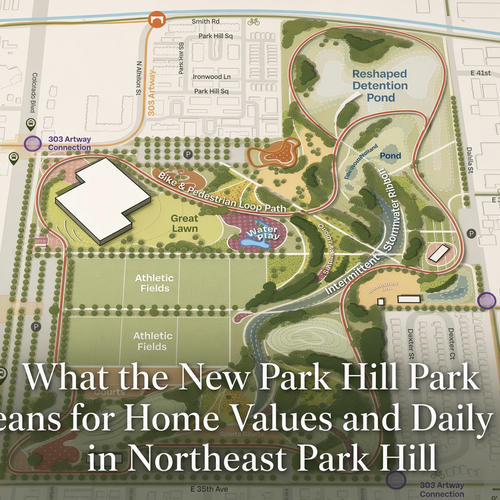
Northeast Park Hill is generally where buyers can stretch their dollar furthest within Greater Park Hill, but the lower price point comes with a different housing profile and a different set of neighborhood considerations.
The latest Realtor.com snapshot available for Northeast Park Hill is from June 2026. It shows a median sold price of $530,500, median listing price of $492,450, $352 per square foot and 53 median days on market. The neighborhood had 58 active listings at the time of the snapshot.
That roughly $530,500 median sold price is almost $400,000 below the South Park Hill median. The difference is large enough that a buyer should not think of Northeast Park Hill simply as "discounted South Park Hill." The housing stock and the surrounding context are materially different.
Northeast Park Hill includes a substantial amount of postwar housing. Individual properties in the area include brick ranch-style homes from the 1950s, often with practical floor plans, larger yards and substantial renovation potential. For buyers comfortable with updating kitchens, bathrooms, finishes or mechanical systems, that can be an important source of value.
The buyer profile is therefore somewhat different. Northeast Park Hill can make sense for someone who prioritizes square footage, yard, affordability or renovation upside over having the most architecturally distinctive house or the closest proximity to City Park.
What does $650,000 actually buy in each section?
The most useful way to compare the three areas is to think in terms of what your budget allows you to compromise on.
| Area | Latest reported median sold price | Median days on market | What the buyer is typically trading toward |
|---|---|---|---|
| South Park Hill | $926,500 | 37 | Architecture, established streetscapes, proximity to City Park and premium housing stock |
| North Park Hill | $654,500 | 45 | Park Hill character at a lower entry point, with more variation in housing stock |
| Northeast Park Hill | $530,500 | 53 | Lower purchase price, larger value gap and greater renovation opportunity |
The figures come from different 2026 reporting snapshots, so they should be used as a framework rather than a formal comparative market analysis.
A buyer with $650,000 illustrates the difference particularly well. In North Park Hill, that budget is close to the neighborhood's reported median sold price. In Northeast Park Hill, it is meaningfully above the median, potentially allowing the buyer to be more selective about condition. In South Park Hill, $650,000 would place the buyer well below the neighborhood's reported median sold price and likely require a significant compromise in size, condition, location or some combination of the three.
That is the real meaning of "value" in Park Hill. It is not simply getting more square footage for your dollar.
The best Park Hill value may be the house with the right problem
Having renovated older Denver homes, I think buyers sometimes make the mistake of treating renovation as either a positive or a negative. The more useful distinction is between a house with expensive problems and a house with fixable problems.
A dated kitchen is visible and relatively easy to understand. A foundation issue, obsolete electrical system, drainage problem or major structural alteration can be much harder to price accurately before closing.
My rule for evaluating an older Park Hill house is simple: pay for location and architecture you cannot create, but be disciplined about paying for finishes you can add later.
That does not mean every fixer is a bargain. A $600,000 house requiring $250,000 of work is not automatically better value than a $750,000 house that is already renovated. The right comparison is the projected all-in cost, the quality of the finished product, the property's position within its block and the ceiling for comparable homes nearby.
This is where the differences among the three sections become especially useful. South Park Hill gives buyers more opportunities to acquire architecture and location that would be difficult to replicate. North Park Hill can offer a middle path. Northeast Park Hill can offer more room for improvement, but buyers should be particularly rigorous about understanding what the renovation can realistically accomplish.
In 2026, buyers should compare Park Hill sections by total ownership cost, not just purchase price
The Denver market is giving buyers more room to think. September closed sales were down 21.39% year over year, active listings were up 3.72%, and the overall close-to-list ratio was 98.45%. At the same time, the year-to-date median close price for detached homes remained $650,000, matching the prior two years.
That combination creates an unusual environment. Buyers are not necessarily getting dramatically cheaper houses, but they have more opportunities to negotiate and more time to evaluate whether a property's condition justifies its price.
For Park Hill buyers, I would evaluate each house through four questions:
What am I paying for that cannot be changed? Think location, lot, mature trees, architecture, block and proximity to the amenities you actually use.
What can be changed? Kitchens, bathrooms, finishes and some layouts may be relatively straightforward compared with structural or site issues.
What will the finished house compete against? A renovation only creates value if buyers in that micro-market will pay for the result.
What happens if I have to sell in five years? The best renovation is not necessarily the most expensive one. It is the one that leaves the property appropriately positioned for its neighborhood.
That framework can produce very different answers for three houses priced at $650,000, $750,000 and $900,000.
The right choice depends on what you want Park Hill to do for you
South Park Hill makes the most sense for buyers who place a premium on architectural character, established streetscapes and proximity to City Park and are willing to pay more for those attributes.
North Park Hill can be compelling for buyers who want much of the Park Hill experience but have a tighter budget or want to put some of their capital into renovation rather than purchase price.
Northeast Park Hill is often the most compelling option for buyers focused on affordability and upside, particularly if they are comfortable owning and improving an older or mid-century home rather than expecting a turnkey property.
There is no universally "best" section. The better question is whether the premium you are paying is buying something you genuinely value.
That is ultimately how I think about Park Hill real estate. The three sections share a name, but they do not offer the same housing, the same price point or the same risk-reward equation. For buyers willing to look beyond the headline price, those differences can create some of the most interesting opportunities in Denver's older neighborhoods.
If you're considering a Park Hill purchase, renovation or move between the three sections, Let's connect and compare the tradeoffs against your budget and priorities.
The most useful next step is usually to look at actual houses, not just neighborhood statistics. A side-by-side comparison of recent sales, current listings, renovation needs and block-level differences can reveal whether the premium for one section is justified for your particular goals.
Key Takeaways
South Park Hill is the premium section by current median sale price. Realtor.com's August 2026 snapshot shows a $926,500 median sold price and 37 median days on market, reflecting the premium buyers place on its established housing stock and location.
North Park Hill offers a middle-ground entry point. Its August 2026 median sold price was $654,500, with 45 median days on market, putting it much closer to the broader Denver detached-home price level than South Park Hill.
Northeast Park Hill has the lowest reported median sold price. The June 2026 median was $530,500, with 53 median days on market, creating more room for buyers whose priority is affordability or renovation upside.
Price per square foot changes the story. North Park Hill's reported $447 per square foot was higher than South Park Hill's $381 and Northeast Park Hill's $352, demonstrating why buyers should not use neighborhood-wide price-per-square-foot figures without accounting for house size, condition and housing type.
Architecture has real financial value, but only when buyers value it. South Park Hill's historic Foursquares, Arts and Crafts, Tudor Revival, French Eclectic and Colonial Revival housing is difficult to reproduce, while North and Northeast Park Hill offer more varied and later-era housing stock.
In 2026, the right comparison is purchase price plus future capital requirements. Denver's September market had 4.76 months of inventory and a 98.45% close-to-list ratio, giving buyers more opportunity to negotiate while making careful property-level analysis more important.
FAQ
Is South Park Hill worth the extra money?
South Park Hill can justify a premium when the buyer values its architecture, established streetscapes, proximity to City Park and larger concentration of historically significant homes. The latest reported median sold price was $926,500, compared with $654,500 in North Park Hill.
Is North Park Hill cheaper than South Park Hill?
Yes, based on the latest 2026 neighborhood snapshots. North Park Hill's median sold price was $654,500 in August, compared with $926,500 in South Park Hill. The difference is roughly $272,000, although the neighborhoods' housing mixes mean this is not a direct apples-to-apples valuation.
Is Northeast Park Hill a good place to buy a fixer-upper?
Northeast Park Hill can be attractive for buyers specifically seeking renovation potential because its lower median price creates more room between acquisition cost and a higher finished value. The key is determining whether the property's lot, structure and location support the renovation before assuming the work will create value.
Which section of Park Hill has the oldest homes?
South Park Hill contains some of the area's most prominent early-20th-century and historic housing, including Foursquares, Arts and Crafts, Tudor Revival and other period styles. Greater Park Hill as a whole, however, contains housing from the Victorian era through the postwar period.
What does $650,000 buy in Park Hill in 2026?
At roughly $650,000, a buyer is around the reported North Park Hill median sold price, above the Northeast Park Hill median and substantially below the South Park Hill median. That means the same budget can produce very different combinations of size, condition and location depending on which section is considered.
Should I buy a renovated house or a fixer in Park Hill?
The better choice depends on the renovation scope and the property's eventual competitive position. Cosmetic work is fundamentally different from structural, drainage, foundation or major systems work. A useful rule is to pay a premium for characteristics you cannot create, such as a great lot or architecture, while being cautious about paying a premium for finishes you could reproduce yourself.
Are Park Hill's three sections really different real estate markets?
Yes. They share a common identity and history, but their housing stock, pricing and buyer tradeoffs differ enough that a buyer should analyze them separately. Denver Public Library identifies Northeast Park Hill, North Park Hill and South Park Hill as the three smaller neighborhoods that make up Greater Park Hill.
Check out this article next