


Summary
The Park Hill homes that tend to offer the strongest combination of renovation potential and resale appeal are those with durable original architecture, usable floor plans, and enough lot or interior space to accommodate thoughtful updates. Tudor, Mediterranean Revival, brick bungalows, and other early Denver homes can all perform well, but condition, layout, scale, and renovation quality matter more than architectural style alone.
Park Hill is one of Denver's most interesting neighborhoods for older-home buyers because the architecture is not simply decorative. The style, construction, floor plan, lot, and relationship between the original house and later additions can materially affect what a homeowner can do with the property.
That creates an important distinction for anyone considering a renovation: the most attractive house is not necessarily the house with the most renovation potential.
A home with beautiful clinker brick, leaded glass, original woodwork, or a distinctive roofline may command attention immediately, but those same features can make careless remodeling particularly damaging. Conversely, a less visually dramatic house with a strong structure, sensible floor plan, and room to expand may provide considerably more flexibility.
Having renovated older Denver homes myself, I have learned to look at these properties in layers. First comes the architecture and what should be preserved. Then comes the underlying house: structure, systems, layout, basement, lot, and potential for expansion. Only after that do I think about finishes.
That order matters because renovation decisions ultimately become real estate decisions. A $100,000 improvement that makes a house more functional and more desirable is very different from a $100,000 improvement that simply makes an already expensive house more expensive.
Which architectural styles are most common in Park Hill?
Park Hill contains a remarkably varied collection of early Denver housing, including Tudor, Mediterranean Revival, brick bungalows, Foursquares, Craftsman-influenced homes, and other early-20th-century designs. The important point for buyers is that these styles do not all provide the same renovation opportunities.
| Style | Typical renovation opportunity | Primary consideration for resale |
|---|---|---|
| Tudor | High, particularly when original character is intact | Preserve distinctive architectural details |
| Mediterranean Revival | High, especially in larger homes | Expansion should respect the original proportions |
| Brick bungalow | Moderate to high | Floor-plan limitations can matter more than appearance |
| Foursquare | High | Strong potential for reworking interior circulation |
| Craftsman-influenced | Moderate to high | Original millwork and proportions are valuable |
The table is a starting point, not a ranking. Two houses built in the same architectural style can have dramatically different renovation prospects because of their lot dimensions, existing additions, basement configuration, structural condition, and location within Park Hill.
That is particularly important in a neighborhood where buyers often respond strongly to architectural character. A renovated historic-looking house is not necessarily equivalent to an authentically preserved older home.
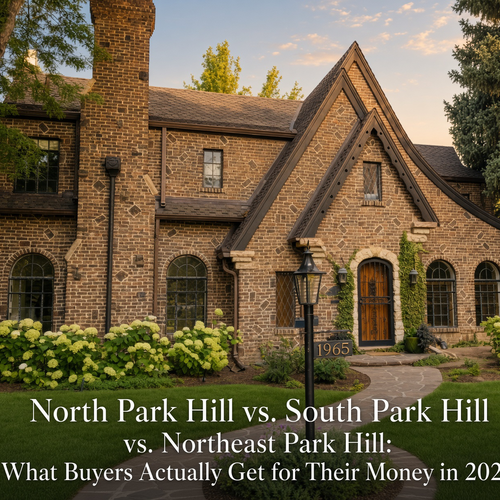
Tudor homes can offer an unusually strong renovation balance
Tudor homes are often among Park Hill's most recognizable properties, and their combination of architectural character and substantial interior volume can make them particularly compelling renovation candidates.
The best candidates typically have enough existing square footage that the project can focus on improving function rather than fundamentally changing the house. That distinction is important. Preserving the exterior character while improving kitchens, bathrooms, circulation, mechanical systems, and storage is generally a more coherent strategy than trying to make a Tudor look like a completely different type of house.
For resale, recognizable details can become an advantage because buyers can understand what makes the property distinctive before they ever see the renovation.
That does not mean every original feature should remain untouched. A 1920s or 1930s floor plan may have small kitchens, limited closet space, or circulation that feels disconnected from how families live today. The strongest renovations usually distinguish between character worth preserving and function worth changing.
Mediterranean Revival homes can reward thoughtful expansion
Mediterranean Revival properties can provide particularly interesting renovation opportunities because their architectural vocabulary often works well with larger-scale spaces, outdoor connections, and substantial interior detailing.
Park Hill's Mediterranean Revival homes can include features such as arched openings, plaster or stucco elements, tile roofs, distinctive windows, and formal interior spaces. Those characteristics create both opportunity and risk: an addition that respects the original architecture can feel like it belongs, while an incompatible addition can make the house feel as though two different buildings were joined together.
The practical test I use is simple: Can the proposed renovation make the house substantially more functional without making the original architecture less legible?
If the answer is yes, the project may improve both livability and resale. If the renovation requires removing the features that make the property special, the financial case becomes much harder to justify.
Brick bungalows are often better renovation candidates than buyers assume
Brick bungalows can be excellent Park Hill investments, but they require a different renovation strategy from a larger Tudor or Mediterranean Revival home.
The challenge is usually not architectural appeal. It is volume.
A bungalow may have a relatively compact original footprint, which means adding a large kitchen, primary suite, additional bathrooms, laundry, and modern storage can require more invasive work. Basement finishing or a carefully designed addition may solve some of those limitations, but the project needs to be evaluated against the finished value of comparable homes nearby.
This is where buyers can make a costly mistake. They see a $700,000 or $800,000 house that appears to need $200,000 of work and assume they have found an opportunity. But the correct question is not simply, "How much will the renovation cost?"
It is: "What will this house be worth when the renovation is finished, and will the resulting product compete with the best alternatives in the immediate micro-market?"
That is an investment question as much as a construction question.
The best Park Hill renovation candidates usually share five characteristics
Architectural style matters, but five physical characteristics often matter more when evaluating renovation potential: good underlying condition, a workable floor plan, meaningful original character, sufficient space, and a location that supports the finished value.
I would generally investigate a property in this order:
Architecture: What makes the house distinctive, and which elements would be difficult or impossible to recreate?
Structure and systems: Are the foundation, roof, electrical, plumbing, sewer, heating, and other major components fundamentally sound?
Floor plan: Can the house work better without requiring a wholesale reconstruction?
Expansion potential: Is there basement, rear, or other usable space that can add function without overwhelming the property?
Finished value: What are buyers actually choosing between in this part of Park Hill?
This approach helps separate cosmetic problems from expensive infrastructure problems.
A dated kitchen is visible and easy to understand. An aging sewer line, foundation problem, inadequate electrical service, or poorly executed addition may be less obvious but can have a much larger effect on the renovation budget.
For older Denver homes, I would rather buy the house with the ugly kitchen and strong bones than the house with the beautiful kitchen and hidden infrastructure problems.
Location within Park Hill can matter as much as the architecture
Park Hill is not one uniform real estate market. Buyers can respond differently to homes depending on the street, block, housing stock, lot characteristics, proximity to amenities, and the overall pattern of renovation around the property.
That makes the immediate competition especially important.
A renovation that might make perfect financial sense on one block can be difficult to justify on another if the surrounding homes establish a lower price ceiling. Likewise, a house with an unusual architectural style can become more valuable when it occupies a block where buyers consistently seek historic character.
This is why I would not evaluate a Park Hill renovation using a neighborhood-wide average. The more important comparison is usually between the subject property and the best realistic alternatives a buyer would consider after the renovation is complete.
For example, if your proposed project creates a four-bedroom, three-bath home with high-end finishes, the relevant question is not simply what four-bedroom homes sell for across Park Hill. It is what other four-bedroom homes with similar architectural character, square footage, outdoor space, and condition are competing for the same buyer.
That distinction can materially change the renovation decision.
Preserve the expensive-to-recreate features
Original architectural elements should generally be treated as assets, not obstacles to modernization.
In Park Hill, that can include original brickwork, leaded-glass windows, woodwork, fireplaces, ceiling details, built-ins, distinctive doors, tile, and unusual architectural proportions. Removing these elements may make a renovation easier, but it can also eliminate some of the characteristics that differentiate the property from newer construction.
My preference with older Denver homes is usually to modernize around those features rather than modernize by removing them.
A useful test is to ask whether a future buyer could walk into the finished house and immediately understand why it is a Park Hill house rather than simply a newly renovated house that happens to sit in Park Hill.
That distinction becomes particularly important at higher price points, where buyers have alternatives. If two homes offer similar square footage and finishes, the property with genuine architectural character may have a stronger emotional reason for a buyer to choose it.
Renovation quality affects resale more than renovation spending
The most expensive renovation is not automatically the best renovation for resale. In older neighborhoods, the strongest projects tend to align the quality of the renovation with the architecture, location, and price level of the property.
A useful rule is to think in terms of coherence rather than extravagance.
A 1930s Park Hill home does not necessarily need a completely contemporary interior. In fact, an overly generic renovation can remove the very character that makes the property desirable. At the same time, preserving every original room and finish without addressing poor circulation, outdated systems, or inadequate functionality can leave the home difficult to live in.
The goal is to make the house feel substantially better without making it feel less like itself.
That is also where resale psychology comes into play. Buyers often respond to a property emotionally before they have analyzed the individual improvements. A house that feels authentic, functional, and thoughtfully updated can create a stronger impression than one where every component is technically new but the overall design feels disconnected.
The strongest Park Hill renovation strategy is usually selective, not maximal
For buyers considering an older Park Hill home, the best renovation opportunity is often the property that needs enough work to create meaningful upside but does not require rebuilding the entire house.
I would be cautious when the project simultaneously involves major structural work, extensive system replacement, substantial additions, and a complete interior redesign. At that point, the project can begin behaving financially like new construction while retaining the constraints of an older house.
The sweet spot is often a property where the expensive fundamentals are manageable and the renovation dollars can be concentrated on function, layout, preservation, and design.
That is particularly relevant in Park Hill because the neighborhood's architectural character is itself part of the value proposition.
The question is therefore not simply, "Which Park Hill architectural style holds up best?"
It is more useful to ask: "Which house gives me the best combination of character I cannot recreate, problems I can solve, space I can improve, and finished value I can reasonably support?"
That is the question that turns an interesting old house into a potentially smart real estate decision.
If you're considering buying, renovating, or selling an older Park Hill home and want to stay connected to my perspective on Denver architecture and real estate, Let's connect.
If you are evaluating a Park Hill property and want to understand where its architectural character creates opportunity, where renovation risk begins, and how the finished home would compare with competing properties, I would be happy to talk through the property and the numbers with you.
Key Takeaways
Architectural style matters, but condition and layout matter more. Tudor, Mediterranean Revival, brick bungalow, and Foursquare homes can all be strong renovation candidates when the underlying structure, systems, and floor plan are workable.
Preserve features that are difficult to recreate. Original brickwork, leaded glass, woodwork, fireplaces, tile, built-ins, and distinctive proportions can differentiate an older Park Hill home from generic renovated or new construction.
Evaluate renovation against the finished value, not the purchase price. The relevant comparison is what buyers will pay for the completed property versus the best competing homes in the immediate micro-market.
Be especially careful when a project starts resembling new construction. If a renovation requires major structural work, system replacement, significant expansion, and a complete interior reconstruction, the risk profile changes substantially.
The best renovation is usually coherent rather than extravagant. Modern function can coexist with historic character when the renovation improves the house without erasing what makes its architecture distinctive.
Park Hill should be evaluated block by block. Street, lot, housing stock, surrounding renovations, and the local price ceiling can materially affect whether an ambitious renovation makes financial sense.
Frequently Asked Questions
What architectural styles are common in Park Hill?
Park Hill contains Tudor, Mediterranean Revival, brick bungalow, Foursquare, Craftsman-influenced, and other early-20th-century homes. The variety is one reason architectural character can play such an important role in buyer appeal and renovation strategy.
Are Tudor homes good investments for renovation?
They can be, particularly when the original architecture is intact and the existing square footage provides enough room to improve functionality without fundamentally altering the house. The strongest projects typically preserve distinctive exterior and interior details while modernizing kitchens, bathrooms, systems, and circulation.
Are Park Hill bungalows difficult to renovate?
Not necessarily, but their relatively compact original footprints can make major additions more important. Buyers should evaluate whether the basement, rear of the property, or another expansion opportunity can provide the additional space needed without pushing the finished value beyond what the immediate market can support.
Should I preserve original features in an older Park Hill home?
Generally, yes when the feature is distinctive and architecturally significant. Original brickwork, leaded glass, woodwork, fireplaces, built-ins, tile, and unusual proportions can be difficult to recreate and may help differentiate the property at resale.
How much should I spend renovating a Park Hill home?
There is no responsible single dollar amount without knowing the property, scope, existing condition, and likely finished value. A better rule is to establish the realistic post-renovation value first, then determine whether the purchase price plus renovation and contingency leaves enough margin for the risk being taken.
Is it better to renovate an older Park Hill home or buy one that is already updated?
It depends on the price difference and the quality of the existing renovation. A dated house with strong bones can offer an opportunity to create a highly specific result, while a turnkey home reduces construction risk and uncertainty. The comparison should be based on total cost, finished value, time, and risk rather than purchase price alone.
Does architectural style affect resale value in Park Hill?
Yes, but indirectly. Architectural style can influence buyer demand and emotional appeal, while condition, layout, size, lot characteristics, location, and renovation quality determine whether that appeal translates into competitive market value. The strongest properties generally combine recognizable character with modern functionality.
Check out this article next